Teaching lifestyles of gifting and sharing through a set of values, theories, and histories of intentional community, the regional commonwealth, and the Fourth World.
Make the alternative culture GREAT AGAIN! Learn to teach intentioneering of the Democratic Commonwealth, as a method for opposing Dark Enlightenment autocracy, by building ecovillage forms of intentional community, especially the newest form called the land cooperative.
Learn to live with people as you want people to live with you.
Co-create and enjoy the alternative culture Collective Dream, as gifting and sharing lifestyle alternatives to the American Dream!
Global Ecovillage Network – United States, publisher of “Communities” magazine, is now the fiscal sponsor of School of Intentioneering (SoI), through which tax-deductible donations can be sent! Support the mission of SoI of training teachers spreading knowledge about the cultural alternatives of neo-tribal intentional communities and countercultural regional commonwealths, and of GEN-US, with a donation here: http://www.gen-us.net/soi Be sure to specify or tag your donation for “School of Intentioneering” or simply “SoI.” The tax-exempt organization EIN# is: 62-1793769
Invitation to Movement-Making: School of Intentioneering
Make Alternative Culture GREAT AGAIN! Co-create the Democratic Commonwealth and oppose Dark Enlightenment autocracy by building ecovillage intentional communities: cofamilies, cohousing, communal societies, community land trusts, housing cooperatives, and land cooperatives (REICs)
The GREAT AGAIN! link is to a Google Docs folder with ten free downloadable PDF articles focusing upon the land cooperative or real estate investment cooperative (REIC) form of equity sharing, plus the City of Boston’s information on tenants-in-common:
Great Again Lifestyles!
Community Investment Funds
The Land Co-op: Seven Real Estate Investment Cooperatives (REIC) featuring EB PREC
Real Estate Agents for the Common Good, organizing housing cooperatives, limited-equity, community land trust, or tenants-in-common intentional communities
Black, Indigenous, People of Color Intentional Community Council (BIPoC ICC) – BIPOCICC.org
Forums, Facebook Groups, workshops, trainings, resource directory, and monthly online conversations providing inspiration and building solidarity
Attracting donations funding a grant program supporting BIPoC intentional communities
What does the cultural left have for countering the attempts of the cultural right to recruit young adults to neo-fascist extremism? Neo-fascism has websites, meetings, and actions attracting young adults with conspiracy theories and the distortions of alternative facts opposing liberalism and leading to violent extremism. We have seen this before; in Hitler Youth of 1930s Germany. Today in America that same playbook is in use by the politically conservative Right. In response, the politically liberal Left needs to chart an alternative: COLLECTIVIZE!
Religion is not something set in stone; it changes with time as human culture changes. In fact, religion, like economics and governance, is used to design, build, and maintain a preferred culture. Thus, the patriarchal culture of the Religious Right needs to be replaced with partnership culture of the Religious Left.
Culture can be given, or it can be a matter of choice. Human culture evolves as people decide what they choose to believe and how to live. When an ecopartnership culture is necessary, oppression and exploitation are replaced with liberty and solidarity. When gender-equality is necessary, patriarchal culture is replaced with partnership culture, which especially requires replacing patriarchal religion with Partnership Spirituality.
• Teaching Parallel Cultures in the School of Intentioneering
• The Wandervogel by John de Graaf
Reprinted with permission: John de Graaf
• Non-Christian and Christian Youth Movements
• If People Wanted to Live Communally, There Would Be More of It
• The Solution to Economic Collapse for Wall Street Banks
• Riding-Out the Storm in the Ecovillage
• Teaching Counterculture in the School of Intentioneering
• The Parallel Cultures of the Cofamily Collective Dream and the American Dream Nuclear Family
• Intentioneering the Fourth World Commonwealth
• References
Teaching Parallel Cultures in the School of Intentioneering
Learning about and teaching the nature of the dominant culture and of the alternatives to it is the mission of the School of Intentioneering. Politics, economics, religion, and other aspects of culture are all in constant states of change, often returning to similar themes developed and experienced in the past. Knowing what has come before and how that history echoes in the present provides opportunities for avoiding the reinvention of wheels, while showing best practices for how to drive our society in a preferred direction.
Understanding political, economic, and cultural history leads to the theory of parallel cultures, recognizing that there has always been and likely always will be times of tension and conflict, as well as times of accommodation, tolerance, and co-existence of two different world-views and cultures. The two parallel cultures are identified in different ways at different times, usually corresponding to the political concepts of right and left, the economic concepts of private and common property, the social concepts of conservative and liberal, and the religious lifestyles of patriarchy and partnership.
In the absence of beneficial and constructive visions people respond to challenges and crises with anxiety, cognitive dissonance, and denial, often turning to dystopian beliefs and manipulations fed by conspiracy theories, exclusivity, and violent extremism. Positive alternatives are needed to counter the negativity, by focusing upon cultural designs that assure nurturing, inclusive, socially and environmentally responsible lifestyles accessible to all through the future. Teaching positive alternatives is the School of Intentioneering mission.
In a democracy citizens can be as liberated as free birds! While people value the freedom of individual autonomy and of self-direction, many also enjoy being part of agglomerations, such as being one of thousands of spectators at a ball game, a member of a graduating class, or of a faith community. Such groups can be considered human murmurations, in ever changing social configurations.
Gregarious people enjoy being one-of-many, tending to their personal role in a group, large or small, with a common idea or mission. That must be similar to what an individual starling thinks and feels when it joins a flock in murmuration, managing its own flight in coordination with others!
Some people enjoy the American Dream murmuration, and others the Collective Dream murmuration. These are as two flocks with different news feeds and subsequent world-views: conservative and liberal, right and left. “Collective” can mean cooperative, communal, or any sharing lifestyle.
America has always been a divided nation. Surprisingly, the 19th century American Civil War between North and South is thought to be a continuation of the 17th century English Civil War, which was transferred to, then evolved in, North America. The English Civil War was between monarchists supporting classist society and culture, some of whom later immigrated to the southern British Colonies on the North American east coast, and parliamentarians supporting limited representative democracy, some of whom later immigrated to the northern American Colonies. In the following American Revolutionary War, about one-third of the Colonists supported the British Crown, one-third supported American independence, and one-third avoided the issue. Later, the American Civil War carried on the division between Southern classist culture and Northern democratic culture.
Going back further, the histories of the Roman Republic becoming the Roman Empire, and the Ancient Greek conflict between autocratic kings and elected democratic leaders, shows that the ongoing American Culture War is our contemporary manifestation of the dual nature of human-kind, that of competition and domination versus cooperation and freedom. This has always been an issue in our civilization. Marija Gimbutas shows that even in our prehistory there was conflict between egalitarian partnership-oriented and authoritarian patriarchal-oriented cultures. (Gimbutas, xv, xvi, 176)
In the 20th century the division between autocracy and liberal democracy resulted in two World Wars, with WWII being a continuation of aspects of the First World War. WWII saw a division between the fascist political-economic right and the liberal political-economic left. The subsequent Cold War between the victors of WWII replaced fascism with communism as the opponent of liberal democracy.
In 21st century America we have the Republican right versus the Democratic left, both with corresponding conservative-versus-liberal social movements, including a Religious Right and a Religious Left. The contemporary conflicts between these extremes may be seen as the ongoing tension between two opposing world-views, reappearing throughout history, manifesting again in our time for us to carry on the never-to-be-resolved struggle.
Today, the conservative right wing has allied with neo-fascist extremism, with its high-water mark so far being the 2021 storming of the U.S. Capitol building. Neo-fascists are actively recruiting youth into their movement with online appeals of ideology, leading to meetings and actions. Mean while, the liberal left is less visible. Anti-fascists use a diversity of tactics from non-violent direct action to violence, with those engaged in the latter called “Antifa.” In some ways, the 2020s are developing to be much like the 1920s, with the naiveté of youth in both cases being susceptible to manipulation by conspiracy theorists and angry militant groups seeking new recruits. John de Graaf ‘s 1977 article The Wandervogel shows parallels between 1920s Germany and 1960s American youth movements, which can now also be seen in the 2020s in at least America and probably Europe and elsewhere.
John de Graaf’s entire 1977 article The Wandervogel, the literal translation being “Wandering Birds,” is included in this paper for its instructional value in how apolitical youth movements can be co-opted by neo-fascist extremists. That is not exactly what is happening in America and Europe in the 2020s, yet being aware of the history should aid understanding of the present, and planning for the future.
Non-Christian and Christian Youth Movements
The German Wandervogel youth movement started in 1896, and is described by Peter Stachura in his book Nazi Youth in the Weimer Republic as a “mainly Protestant, urban middle-class phenomenon … of escapist romanticism.” John de Graaf explains that these were the disaffected children of prosperity, reacting against the rapid “harsh, complex, and materialistic” industrialization of their German homeland, which supported both their comfortable German working class and their prosperous middle class. The literal translation of Wandervogel is “the wandering birds,” translated to American English as “Free Birds!” (de Graaf, pp. 14, 15; Stachura, quoted in de Graaf, pp. 20-21)
The Wandervogel movement then went dormant when World War I began in 1914, reforming during the 1920s between the world wars, going dormant again with the beginning of World War II. The movement involved: free schools teaching gender-equality as in Denmark and Spain; food, housing, and other cooperatives; long hair on men; back-to-nature rural communes; sexual freedom; a rejection of conventional Christianity in favor of mysticism and Eastern Religions; internationalism replacing nationalistic patriotism; and a resistance to politics with the sentiment that “Our lack of purpose is our strength,” as Walter Lagueur wrote in Young Germany. De Graaf writes, “Because they had so long been unconcerned with practical political questions, they were impotent when disaster struck.” That disaster was Adolf Hitler’s fascist dictatorship “National Socialism.” (de Graaf, pp. 14-18)
The 1960s countercultural movement spread around the world, and the 2020s are showing significant countercultural youth activism for racial justice, women’s rights, and for collectivization through mutual aid groups, cooperatives, community, cofamilies, and worker solidarity. (de Graaf, pp. 14)
There is one organization that has survived from the 1920s German youth movement. German Christian youth were inspired to activism by the times, even though the primary sentiment was non-Christian. This is the Bruderhof, a Christian communal group also called the Society of Brothers, which today has about 3,000 members in about 25 communities, mostly in the United States.
Emmy Arnold, wife of the Bruderhof founder, Eberhard Arnold, wrote in the 1974 second edition of the book Children in Community, …
“In Germany after the First World War, the Youth Movement arose and was very much alive in our Christian circles. My husband, Eberhard Arnold, and I were closely connected with this movement for many years. We were part of a group of people who often met in our home in Berlin in a search for a new, genuine way of life. A few of these people felt together the very
strong urge to build up a life in truthfulness, simplicity, and poverty, as opposed to the life we saw everywhere around us.
“In the year 1920 this community life came into being; a very simple life in complete sharing was begun by a little group in Sannerz, Hesse. This life in community has continued for over fifty years. We have gone through sorrow and struggle, yet we have known deep joy and enthusiasm.
“A life shared in common is a miracle. People cannot remain together for the sake of traditions. Community must be given again and again as a new birth.” (Society of Brothers, p. 173)
The Bruderhof “genuine way of life” was of course incompatible with Nazism, and so like all the other “new religions and occult sects whose prophets grew like mushrooms,” as Walter Laqueur wrote, the Bruderhof was targeted for elimination. (Laqueur, quoted in de Graaf, p. 16)
Formed in 1920, the Bruderhof sect was raided in 1937 and its leaders imprisoned. They were saved when their jailers were called to one of the Nazi Party rallies in Nuremberg with its searchlight nighttime spectacle, enabling the remaining jailer crew to set free the Bruderhof members. All the remaining Bruderhof members sought asylum first in England then elsewhere, yet were refused everywhere except Paraguay, due to concerns that they may be German spies. After WWII the Bruderhof immigrated to the U.S.A.
If People Wanted to Live Communally, There Would Be More of It
Why are there not more people living communally today? We became human while living in small communal groups for hundreds of thousands of years before civilization, and it has been shown in various studies that our brains have thereby been conditioned for community and cooperation.
In People of the Lake: Mankind and its Beginnings Richard Leakey and Roger Lewin state that, …
Reciprocal altruism works on the tacit assumption that favors are repaid in roughly the same measure. … The ideal breeding ground for the evolution of reciprocal altruism is in a group of long-lived, egalitarian, social animals who remain close together throughout their lives. … This is precisely what one would expect; over countless generations natural selection favored the emergence of emotions that made reciprocal altruism work, emotions such as sympathy, gratitude, guilt and moral indignation. … Sharing, not hunting or gathering as such, is what made us human. (Leakey & Lewin, emphasis in the original, pp. 120, 136-7)
Researchers at Emory University in Atlanta, GA found a way to determine the differences among people with respect to sharing and possessiveness, and cooperation and competition. Using magnetic resonance imaging, they studied the neural activity in volunteers playing a laboratory game called the “Prisoner’s Dilemma,” which was set up with a reward system that logically and rationally favored competition. Yet they found that the greatest activity in parts of the brain that registers pleasure
resulted when the players cooperated. “In some ways, it says that we’re wired to cooperate with each other.” Yet, ironically, the dominant culture is designed for privacy and competition. (Angier, 2002)
So, why is communalism such a marginal culture? Young adults typically experiment with communalism once they leave the family, or rely upon some form of the sharing lifestyle out of economic necessity, political idealism, or for social connections, yet as people’s income increases, and as they experience the complications of collectivity, most tend to buy privacy and self-reliance.
As the early 20th century Wandervogel history and the 1960s counterculture show, every era of major cultural change typically involves a renewed enthusiasm for communalism among at least young adults. This can be seen all through the history of Western civilization, as presented in the Amazon ebook by the current author, titled: The Intentioneers Bible.
There are a number of reasons why the communal lifestyle is so rare and often short lived. One reason, as shown in the previous section about the German Bruderhof in Nazi Germany, is that the dominant culture of greed, competition, and avarice often persecutes and destroys communal groups. During the German Wandervogel youth movement there was a back-to-the-land movement that did not survive long, partly due to the naiveté of urban youth trying to survive in the country, and partly due to the rise of the Hitler Youth movement, which “copied the trappings and rhetoric of the earlier counterculture, while adding a strong dose of Nazi discipline and ideology.” (de Graaf, p. 18)
The communal Christian Bruderhof movement survived because it managed to get out of Germany before WWII and has since thrived in America, partly because of its centralized management structure, and partly because religion is a strong cohesive force in community. Besides the Bruderhof there are several successful communal religious groups in America, including: Catholic monasticism, which has been drastically shrinking in numbers since 1970 as women have been breaking glass ceilings to find more occupational options than housewife or cloistered nun; some of the Anabaptist Mennonites and most of the Hutterites, both starting in 16th century Europe and immigrating to America; and the American-grown Twelve Tribes or Messianic communities. Some Hindu communities and other communal religious groups have also survived in North America. The only significant secular or multi-faith communal group to survive the 1960s counterculture is the Federation of Egalitarian Communities (FEC), which has not grown as much as have the religious groups, as they have only about doubled in population in forty-five years. The main reasons that the FEC groups have survived is because of their decentralized management structure, the vacation-credit, time-based, non-monetary internal economy used in the largest communities, Twin Oaks and East Wind, and their focus upon gender-equal partnership, all of which substitutes for the role of patriarchal religion in community.
To understand why communalism is not more prevalent today, while privacy and competition is the dominant lifestyle, consider that the process of creating communal society takes people back to the prehistoric, sharing culture long before money was invented, showing how most people subsequently abandoned the sharing of common property for the accumulation and trade of private property.
Whatever things people had learned to make during the late Neolithic era, it is likely that they also learned to barter those things amongst themselves. In the midst of a natural world of plenty, the processes of bartering found-things and human-made things was likely already being developed and practiced. The very same dynamic is seen at Gatherings of the Rainbow Family of Living Light, a countercultural network begun in the American West in 1972, now worldwide, holding regular gatherings usually on public land, involving primitive camping in the wilderness, away from the vehicle parking areas. Even though people bring to the Gathering all necessities for communal sharing, a large number of Rainbows insist upon spreading a blanket on the ground displaying their private property of found and human-made things for trade. Incessant haggling for trades proceeds daily during warm, sunny weather as a pleasant, colorful past-time along the bustling Rainbow Barter Lane.
While there is no use of money for buying and selling at non-commercial Rainbow Gatherings, there is almost always a Barter Lane, a practice that very likely predated the invention of agriculture in our prehistory. Over and over again, Rainbow Gatherings recreate the conditions of Neolithic and earlier human culture, and thereby the very processes that set us on the road to civilization as we know it today. Anyone can experience this dynamic simply by attending a Rainbow Gathering.
For another example of how it is that communalism is not more prevalent today, consider why the dominant culture is comprised of isolated nuclear families living in competition, rather than communal groups living in cooperation. Many people simply find that a family with children meets their needs for togetherness and affection, without the complications of group living. Their children may seek community as young adults, yet upon their having children of their own they tend to return to the social design of the nuclear family. In most cases, no matter how committed one is to the ideal of communal society, once a person has a child, we suddenly prefer to create a nuclear family.
While some religious communal groups invest much effort in keeping their children from leaving the communal society, other communal groups recognize that they do not need children, as they can readily attract adults, usually young adults, to become members and carry on the communal tradition. Why invest in raising children when most likely they will not agree with their parents’ commitment to the sharing lifestyle, and leave when they become adults? 2000 years of Catholic monasticism provides ample proof that children are not needed in communal society. This, plus the irony of temporary autonomous zones like Burning Man and Rainbow Family Gatherings spontaneously generating barter groups for exchanging private property within ostensibly gifting and sharing cultures, shows why communalism is such a marginal culture within the dominant corporate-capitalist, patriarchal culture.
Given the marginality of communalism in contemporary society, there remains the possibility that a dynamic new communal tradition could arise and grow in the right social-political-economic environment. The 12th century saw the high-water mark of Catholic monasticism in Europe, covering as much as one-quarter of the developed land. (Knowles, pp. 77, 83, 96-7) A similar phenomenon could repeat. A future world beset by drastic economic or climate-change-induced dark-age-like disruptions of civilization, typically beginning when children can no longer be educated, could result in a return to collectivism as means of survival. Existing models of egalitarian society, with different levels of collectivity, with or without children, are available when needed. (See: A. Allen Butcher, “Too Much of a Good Thing.” 2023. Self-published. Available with Google Docs link.)
The Solution to Economic Collapse for Wall Street Banks
Susan Strange was the Professor of International Political Economy at the University of Warwick in England, and Emeritus Professor at the London School of Economics. In her 1986 book Casino Capitalism she states, … “The Western financial system is rapidly coming to resemble nothing as much as a vast casino. … As in a casino, the world of high finance today offers the players a choice of games. Instead of roulette, blackjack, or poker, there is dealing to be done—the foreign exchange market and all its variations; or in bonds, government securities or shares. In all these markets you may place bets on the future by dealing forward and by buying or selling options and all sorts of other recondite [i.e., obscure] financial inventions. Some of the players—banks especially—play with very large stakes. There are also many quite small operators. There are tipsters, too, selling advice, and peddlers of systems to the gullible. And the croupiers in this global financial casino are the big bankers and brokers. They play, as it were, ‘for the house.’ It is they, in the long run, who make the best living.” (Strange, p. 1)
Practically any event in the real world could snowball into something that would affect the credit and foreign exchange markets, requiring transnational corporations along with importers and exporters to carefully protect themselves from such risks. The need is then to diversify a company’s capital assets and liabilities, and the best way to do that is by “geographical diversification,” meaning having corporate offices in different countries with different currencies. The result of that long-run strategy, Strange points out, is the tendency of a firm, “to increase their short-term needs for hedging against exchange rate risks, thus adding still further to the volume of transactions in the financial casino.” (Strange, pp. 12-3)
In his 2010 book, On the Brink: Inside the Race to Stop the Collapse of the Global Financial System, the U.S. Treasury Secretary Henry Paulson explained that the stress of the ongoing crisis, later to be called the “Great Recession,” was weighing upon him.
Sunday, September 14, 2008. “Back in my temporary office on the 13th floor [of the New York Federal Reserve bank], a jot of fear suddenly overcame me as I thought for a moment of what lay ahead of us. Lehman [bank] was as good as dead, and American International Group’s (AIG) problems were spiraling out of control. With the U.S. sinking deeper into recession, the failure of a large financial institution would reverberate throughout the country—and far beyond our shores. I could see credit tightening, strapped companies slashing jobs, foreclosures rising ever faster: millions of Americans would lose their livelihoods and their homes. It would take years for us to dig ourselves out from under such a disaster. (Paulson, p. 214)
“All weekend I’d been wearing my crisis armor, but now I felt my guard slipping as I gave in to anxiety. I knew I had to call my wife, … (Paulson, p. 215)
“What if the system collapses?” I asked her. “Everybody is looking to me, and I don’t have the answer. I am really scared.” (Paulson, p. 215)
“You needn’t be afraid,” Wendy said. “Your job is to reflect God, Infinite Mind, and you can rely upon Him.”” (Paulson, p. 215)
Friday, September 12, 2008. Treasury Secretary Paulson called a meeting at the New York Federal Reserve of Wall Street CEOs to come up with a rescue for Lehman Brothers bank. They had to work
together to save one of their competitors, because otherwise the impact upon the financial markets and their own companies could be disastrous. Everyone in the room knew that AIG was now in trouble, and the CEOs asked why they should weaken their companies to help one competitor, if the next rescue to be crafted was going to be an even bigger problem, with more problems beyond that successively impacting the financial industry? Tim Geithner, president of the New York Fed responded, “Let’s focus on Lehman.” (Paulson, pp. 192-3)
For a room full of convinced free-marketers beset by the “classic question of collective action,” the issue became at what point does the good of the group overrule individual needs? If each company now had to be prepared to help its competitors, how then can the worth of any particular company be accurately gauged by the market? (Paulson, p. 198)
The world had suddenly gone topsy-turvy. It was no longer business-as-usual. It was a very unusual business when the assumptions of the capitalist free-market had to be replaced by the necessity of collective survival. The CEOs working with Geithner and Paulson that weekend at the New York Fed were being asked by the government to set aside their individual concerns for the long-range good of their industry. Jamie Dimon of J. P. Morgan pointed out that his bank would act responsibly in this crisis, yet that he “ran a for-profit institution and had an obligation to his shareholders.” The stated goal was to create a private-sector consortium that presumably would be able to aid any other financial-industry corporation that might need it next, like Merrill Lynch or Morgan Stanley. Lloyd Blankfein of Goldman Sachs asked, “Do you think this makes sense? … Goldman will act responsibly. We’ll do our part, but this is asking a lot, and I’m not sure it makes sense.” (Paulson, p. 201)
Lehman Brothers bank collapsed in September 2008 and the government bailout of Wall Street was well underway. The Great Recession was challenging many people to step outside of the free-market box. In the process of responding to a macro-economic threat to the entire country and the globalized financial system, the U.S. Government was trying hard to rescue major corporations without nationalizing them, while the corporations themselves were having to change their competitive skins to begin to look and function like they were part of a collective intentional banking community practicing mutual aid.
Tuesday, September 16, 2008. It was learned that AIG needed $85 billion. Paulson writes, “AIG’s incompetence was stunning.” The previous Sunday that figure had been (only) $50 billion, so how could AIG be sinking so rapidly? They needed $14 billion by the close of the next business day! (Paulson, p. 229)
Secretary Paulson admitted that the proposed solution was essentially to bail out Wall Street. The Fed chairman, Ben Bernanke, explained to President Bush, “We are past the point of what the Fed and Treasury can do on their own.” Now it was up to Congress to revise the nation’s fiscal policy to save the economy, and raise the nation’s debt limit to do it. In his phone conversation with Secretary Paulson, President Bush naively commented, “Someday you guys are going to have to tell me how we ended up with a system like this and what we need to do to fix it.” Friday, October 3 congress passed the Emergency Economic Stabilization Act of 2008 (EES Act). (Paulson, pp. 237, 256-7, 328)
Monday, October 13, 2008. The heads of nine of the largest U.S. banks arrived at the U.S. Treasury building, compelled to attend a meeting where they would have to work together. They waded through a cordon of photographers and reporters on the steps of the Treasury building, entered the conference room, and sat on one side of the Department’s twenty-four-foot-long mahogany conference table, in alphabetical order according to the names of their banks: Bank of America, Bank of New York Mellon,
Citigroup, Goldman Sachs, J. P. Morgan, Merrill Lynch, Morgan Stanley, State Street Corporation, and Wells Fargo. Together they held over half of all bank deposits in the U.S. Facing them was: Henry Paulson, Treasury Secretary; Tim Geithner, president of the New York Federal Reserve Bank; Ben Bernanke, Federal Reserve chairman; Sheila Bair chair of the FDIC; and John Dougan, Comptroller of the Currency. (Paulson, pp. 359, 363)
Secretary Paulson began with saying that they had been summoned because they and their institutions had to work together to save the country’s financial system, their companies, and their own jobs. He explained the solution that the government had devised, of the $250 billion that would be divided among them, and they were to sign a paper before they left agreeing to accept the capital infusions from the Treasury into their banks. (Paulson, pp. 362-3)
Richard Kovacevich, chairman of Wells Fargo resisted. ““I’m not one of you New York guys with your fancy products. Why am I in this room, talking about bailing you out?” … For a moment no one said a word, and then the room suddenly broke out in pandemonium, with everyone talking over one another.” (Sorkin, p. 525)
John Thain of Merrill Lynch asked what all the bankers wanted to know yet that no one else would question, “What kind of protections can you give us on changes in compensation policy?” His concern was that once the government had a stake in their companies, could a populist campaign force changes in the CEO’s pay? (Sorkin, p. 525)
Ben Bernanke interjected, “I don’t really understand why there needs to be so much tension about this, [think about] the collective good. Look, we’re not trying to be intimidating or pushy. …” (Sorkin, p. 526)
In late November Citigroup requested government aid for insuring $300 billion of its toxic assets of mortgage securities and corporate loans, even though in October the Citigroup CEO Vikram Pandit had received $25 billion of the EES Act funds. Without a rescue, Citigroup with $3 trillion in assets, would run out of cash by the following week. (Paulson, pp. 365, 410-1)
Andrew Sorkin states in his book, Too Big To Fail, that before the financial crisis Citigroup had been the largest American financial institution, and as it kept coming back to suck more and more money out of the government, Treasury officials began calling it the “Death Star.” (Sorkin, p. 530)
Secretary Paulson later wrote, “I had become the Treasury secretary who would forever be associated with government intervention and bank bailouts. The speed with which the crisis hit had left me no other choice, and I had set aside strict ideology to accomplish the higher goal of saving a system that, even with all its flaws, was better than any other I knew—I had been forced to do things I did not believe in to save what I did believe in.” (Paulson, p. 408)
There was plenty of criticism to go around. In 2009 Congress created the Financial Crisis Inquiry Commission to analyze what went wrong and how to fix the causes of the Great Recession, publishing its report in 2011 titled, The Financial Crisis Inquiry Report. In their book, All the Devils are Here, Bethany McLean and Joe Nocera wrote, “[I]t was very hard to find the line between delusion, venality, and outright corruption. Much of what took place during the crisis was immoral, unjust, craven, delusional behavior―but it wasn’t criminal.” (McLean and Nocera, pp. 361-2)
Even if his actions were not technically criminal, the person who most deserves to be held responsible for the Great Recession is Robert Rubin, the U.S. Treasury Secretary who “lobbied from his government post in 1999 to repeal Glass-Steagall,” then who as a consultant at Citigroup made $40 million as he worked to help the mega-bank take advantage of the relaxed regulations, then in 2000 he opposed the government regulation of derivatives. Ralph Nader says of Rubin in his 2014 book Unstoppable that, “He has not yet recanted from the gigantic folly of his concoctions. … Rubin experiences no shunning and is on the social circuit in New York and Washington, D.C.” (McLean & Nocera pp. 105-7; Nader, p. 157)
What Bethany McLean and Joe Nocera express, of course, is what is called, “business as usual.” Financialization is essentially the creation of ever more risky, high-stakes games in casino capitalism. Paul Volker, former chair of the Federal Reserve, explained at a Wall Street Journal conference in 2009 his view about financialization that it did practically nothing for the economy. “I have found very little evidence that vast amounts of innovation in financial markets in recent years have had a visible effect on the productivity of the economy.” (McLean & Nocera, p. 363)
Andrew Ross Sorkin states in Too Big to Fail about the unregulated financial instruments called securitized mortgages, collateralized-debt obligations and the various “derivatives” such as credit default swaps and stock options contracts that, “Warren Buffett called them weapons of mass destruction.” (Sorkin, p. 156)
One thing that is not mentioned by any of the authors cited in this story (except Ralph Nader, pp. 142-3), neither Henry Paulson, nor Andrew Ross Sorkin, nor Bethany McLean and Joe Nocera, in any of their conclusions and lists of lessons about the Great Recession, is that the financial cooperatives called “credit unions” had none of the problems of the banks, either before, during, or after the massive economic dislocation of the corporate capitalist system. The only significant impact of the Great Recession upon the credit unions is that membership in the movement substantially increased as people learned that credit unions are safer, have their own government-backed deposit insurance, and are more fiscally responsible than banks. This is an important lesson to keep in mind about the Great Recession, because there are many who believe that the next great economic calamity will be too big for the U.S. Congress to bail out.
Riding-Out the Storm in the Ecovillage
While the corporate dinosaurs were stumbling drunk and crashing, deathly poisoned by financialization, furry little financial cooperatives and ecovillages were nimbly avoiding being squashed in the milieu. Consumer financial cooperatives, called credit unions, had long been established, while the ecovillage movement was just beginning to evolve within the intentional communities movement, at the time that a benefactor found them.
J. T. Ross Jackson had worked as what Karen Litfin states as an international currency trader, who designed computer software to facilitate the business of his profession. In his 1996 Communities magazine article, “The Global Eco-Village Network (GEN): Encouraging Model Ecovillages Worldwide,” Jackson describes his background as having been in “operations research and international finance.” (Jackson, p. 40; Litfin, p. 12)
Evidently, Ross Jackson was one of those people who helped to create the infrastructure supporting the financialization of the international monetary system. Between 1984 and ’86 Jackson designed and sold computer software for the foreign exchange currency markets, managing to get himself in the right place, at the right time, with the right skills, to help bring on the greatest crisis in neo-liberal market capitalism since the 1930s Great Depression. Surely, if Ross Jackson had not done it, someone else would have.
What probably no one else would have done, however, is rather than live a life of leisure with his earnings, Ross Jackson started a foundation named Gaia Trust to fund the nascent ecovillage movement. As Jackson explains in Kali Yuga Odyssey, a spiritual experience he had with Swami Muktananda inspired him to use his skills and resources to support what at the time was a very young ecovillage movement. Ross and partner Hildur had early-on been involved in the beginning of the cohousing movement in Denmark, living twenty years in the community they helped found.
Redeeming himself for having participated in bringing-on, and profiting from, the greatest global financial evil in a century, Ross Jackson co-created a movement, the Global Ecovillage Network (GEN), that promises the best hope for survival through not only economic collapse, yet also potentially though the ecological collapse which is daily growing ever more imminent.
In the 2016 Communities magazine article, co-authored by Ross and Hildur Jackson titled, “The Global Ecovillage Network: Focal Point for a Global Movement,” the authors state, …
Whether the global economy collapsed or we were able to make a planned transition to a sustainable future, I understood that it would be necessary in either case to build a new culture. At the foundation of this culture must necessarily be sustainable human settlements, and for this we needed good models. I believed that a network of ecovillages that provided such models would be an extremely valuable base on which to build. (Jackson & Jackson, p. 14)
For sixteen years, from 1987 to 2003, the Gaia Trust funded the start-up of Global Ecovillage Network centers around the world, then supported ecovillage training programs, including the “Sustainability Wheel” method of teaching the many related topics, published in Hildur Jackson’s and Karen Svensson’s 2002 book, Ecovillage Living: Restoring the Earth and Her People. (See: http://www.Gaia.org)
As the forces of ecological disaster by global warming, and of economic disaster by financialization of the economy, continue to build toward the next global economic implosion, the work of Ross Jackson to help build the counterculture, which is defined by Theodore Roszak in The Making of a Counter Culture as “a culture so radically disaffiliated from the main-stream assumptions of our society that it … takes on the alarming appearance of a barbaric intrusion,” may be considered keen visionary foresight for supporting the next step of humanity out of the Anthropocene of human disruption of nature and into the Symbiocene of human-and-nature harmony.
Teaching Counterculture in the School of Intentioneering
There had been no imperative compelling enough to provide sufficient reason for global intentional community movement networking beyond affinity networks and regional associations until the advent of the ecovillage concept and the founding of the Global Ecovillage Network. No political, economic, or social concern or identity has ever motivated cross-movement networking of intentional communities as has the concern for the environment and the desire to live in harmony with it.
The term “intentional community” was developed for an international conference of collective settlements in 1949, not long after World War II, aided by conscientious objectors of the war. The resulting organization called the “Fellowship of Intentional Communities” (FIC) was reformed in 1986 by the next generation of communitarians or intentioneers with a name-change to the “Fellowship for Intentional Community.” In 2019 yet another new generation renamed the organization again to the “Foundation for Intentional Community.” The word “intentional” was originally chosen due to its connotations of intent, purpose, and commitment, and the word “fellowship” was used to emphasize friendly relationships among people in different intentional communities, which became the primary value of regular FIC meetings. For a group to be called an “intentional community” a minimum of two families and one single male, or five adults, would need to be living “close enough together geographically to be in continuous active fellowship.” (Morgan, Griscom, pp. 9-10) Over the decades the FIC has gradually developed various programs for networking the world of communities, and has allied with various other organizations such as the Global Ecovillage Network (GEN).
GEN has published a book for the Ecovillage Design Education (EDE) curriculum taught around the world since 2005 called, Teacher’s Guide: Design for Sustainability (see: http://www.GaiaEducation.org). GEN rarely uses the term “intentional community,” and it is hard to find it in the GEN Teacher’s Guide. This may be partly due to GEN publications coming from Europe, while the term was coined in the United States. Essentially, GEN substitutes the term “ecovillage” for “intentional community,” making the two terms almost synonymous, although not entirely, since on page 127 of the Teacher’s Guide it is written, “… ecovillages and other intentional communities.” This acknowledges that not all intentional communities can or want to be called an ecovillage. Yet the entire book is about intentional community, which becomes most apparent in the chapter “Choosing Community Legal Structures.”
For the School of Intentioneering, the current author uses a minimum of three non-related adults, rather than five, to constitute an intentional community (IC), and begins with affirming that there are two general types of ICs: nonprofit and for-profit.
Prior to the 21st century, most ICs were nonprofit, with only a few being for-profit, the latter organized as joint-stock corporations, cooperative corporations, or as what the current author calls “class-harmony” communities. In the 1960s and ‘70s the cohousing movement developed in Europe, coming to the U.S. in the late 1980s as a for-profit community design. Cohousing is now a world-wide movement, with some cohousing groups calling themselves ecovillages and some not. Nonprofit ICs incorporate in their state as not-for-profit organizations, some of which then obtain IRS tax-exempt status. Most nonprofit ICs hold their land in common and may be called “community land trusts,” although not all do. Some land trust communities and those with fully communal economies obtain some form of tax-exempt status. In 1936 the U.S. Congress created a tax-exempt status specifically for communal societies called 501(d) “Religious and Apostolic Associations.” Many Christian ICs use the 501(d) form of organization, including Hutterite and Bruderhof communities, along with the multi-faith Federation of Egalitarian Communities.
There is much confusion in the use of terms for classifying and describing different types of intentional community. As with the issue of the terms “ecovillage” and “intentional community” being nearly synonymous, the term “kibbutz” is now also synonymous with IC, since 75% of the once strictly communal kibbutz movement has now privatized to forms of cohousing on government-owned land trusts. With many new people joining or writing about ICs, people tend to use terms indiscriminately.
To reduce the confusion in how people refer to and define intentional community, the School of Intentioneering uses economic classifications based upon how the communities are legally structured. At the bottom of the graphic called Forms of Legal Organization Used by Intentional Communities on the previous page is a table titled, “The Economic Continuum: Showing which Legal Structures are used for particular forms of Intentional Community.” The economic continuum used ranges from “Sharing Commonly-Owned Property” to “Sharing Privately-Owned Property,” with mixtures, or those communities having both commonly-owned and privately-owned property, in the middle, called “Economically-Diverse Community.” There are other ways to classify the many different types of intentional community, with each commentator on the movement tending to use common terms in different ways. While people can call any community at hand what ever they like, clarifying the type of economic system and the legal structure used by the community can minimize the confusion.
As taught in the School of Intentioneering, the issue of sharing versus privacy is answered differently in different types of intentional community. In communities like cohousing which share privately-owned property one begins with the assumption of privacy and asks, “How much am I willing to share?” In contrast, in communities which share commonly-owned property, like communal societies, one begins with the assumption of sharing and asks, “How much privacy do I need?” The difference is in the often-expressed conflict between individuality and collectivity, and each community design finds an appropriate balance between these levels of consciousness, such that ideally neither the individual nor the group is submerged by the other.
Classifying intentional communities according to their degree of sharing versus privacy in the community refers primarily to how money is used in the community. Of course, communal societies do not use money at all within the community, only for exchange with the outside world. So then, how do communal societies organize production and consumption?
For the School of Intentioneering the type of economy used to replace some of the functions of money in intentional community is called “time-based economics,” contrasting with the “debt-based economics” of the monetary system. Time-based economies use various forms of sharing economies while debt-based monetary economies use various forms of exchange economies, each with opposing theories, as presented in the graphic on the following page. Sharing economies use gifting, fair-share, or labor-quota systems, while exchange economies use labor exchange, barter, or monetary systems.
The most significant aspect of time-based economies, in which all labor is valued equally, is that domestic labor or reproduction is rewarded the same way as all other labor: industrial, business, agriculture, maintenance, and the rest. Since there is no exchange of money or anything else for labor, then obviously all labor is valued equally. Most communal groups that do not have a structured labor system for sharing the work usually fail and dissolve as the problem of the free-rider syndrome causes dissention and withdrawal from the communal group. Religious intentional communities tend to maintain cohesion through their belief system, while secular and multi-faith communities support the highest values and ethical ideals through labor systems. The most involved labor system is called the “vacation-credit, labor-sharing system,” developed at Twin Oaks Community by Kat Kinkade in 1967.
People seek in community the gentle strength, security, and meaningful engagement in the company of like-minded friends, afforded in collective methods of survival through uncertainty. Designing a community lifestyle has different requirements and outcomes than focusing upon the isolated nuclear-family American Dream of the single-family home surrounded by lawns and fencing. In contrast, the Collective Dream focuses upon building social capital as security against changing times and fortunes, valuing the clustering of housing and work spaces in order to provide as much space as possible for gardens and other living things.
Collectivization is a method for creating a lifestyle of mutual aid amongst a group of unrelated people sharing common affinities, understandings, and agreements, as well as a natural response to threat. Collective Dream communities can be comprised of unrelated individuals, or of a group of nuclear families with or without unrelated individuals. For the definitions used in the School of Intentioneering, small groups of 3-to-9 related and unrelated children and adults are called both a “cofamily” and a form of small intentional community. The “co” prefix in “cofamily,” just like in “cohousing,” is unspecified as it can mean: collective, combined, communal, community, compersion, complex, complicated, composite, or cooperative family. While ten people and more is a large enough group to adopt aspects of a specific form of intentional community, such as a communal society, cohousing, community land trust, housing cooperative, etc., small cofamilies may be nested within one of those larger forms of intentional community.
While much may be taken for granted among relatives in the patriarchal lifestyle, creating a cofamily requires deliberate effort with regard to finding compatible friends and making and keeping necessary agreements among them. Such cofamilies have always existed. Using the partnership-culture model developed by Riane Eisler of the Center for Partnership Systems, the resources provided by the Foundation for Intentional Community (FIC), and the quarterly journal Communities of the Global Ecovillage Network—U.S. (GEN-US), there is much information and assistance available for creating and enjoying the cofamily lifestyle. (See: http://www.centerforpartnership.org, and http://www.ic.org, and http://www.gen-us.net/communities)
To suggest that the Collective Dream co-evolves with the American Dream as two parallel cultures evolving apace is not so radical an idea considering that the definitions of both the American Dream and the Collective Dream have continually evolved with the development of the country.
In the Gale Student Resources paper How the American Dream Has Changed Over Time it is explained that the concept of the American Dream began with the founding of the country on the premise that, “people could break free from class restrictions and pursue the life they chose … [and] people had the chance to work their way up through their own labor and ingenuity.” This was justified by a seemingly limitless frontier, until the early 20th century when the Great Depression sandwiched between two World Wars again revised the American Dream, to involve government assistance in helping citizens to “work together to make life better for the American masses.” This government aid was seen in the New Deal programs, including those supporting urban collectives and rural communities. (Gale Student Resources in Context, p. 1)
Around the turn of the 19th century into the 20th century there were two “American Dreams,” one for the patriarchal culture “closely tied to home ownership … with products to help improve life at home,” as explained in the 2016 Gale Student Resources paper, and another parallel culture described by Dolores Hayden in her 1984 book Redesigning the American Dream. Hayden coined the term “material feminist” to refer to those who believed that, “women must create new kinds of homes with socialized housework and child care before they could become truly equal members of society.” (Hayden, p. 29)
Between 1870 and 1920 there were many experimental “neighborhood networks” in theory and practice in which women shared domestic work among several households, yet none survived the 1930s Great Depression and 1940s World War II. (Hayden, pp. 67, 72-3)
Beginning in the late 1960s the communal egalitarian communities [see: http://www.theFEC.org] created a successful balance of common and private space, in which men and women shared both domestic-household labor and income-generating work, valuing both equally in time-based economic systems. The most advanced form of time economy is the “vacation-credit labor system” developed at Twin Oaks Community in 1967. Not until the late 1980s in the U.S., with the arrival from Denmark of the cohousing community design, would the private-property design of the “intentional neighborhood” create the same kind of shared gender-roles as the communal egalitarian communities or FEC, now by sharing privately-owned property in cohousing rather than commonly-owned property in communal society.
It is amazing that just a few years after Dolores Hayden published her book Redesigning the American Dream everything that the material feminists wanted began to be realized in the cohousing movement! The “classic cohousing” movement has since become the second largest international intentional community movement after the ecovillage. With the trend of applying the “cohousing” name to a variety of forms of intentional community, just like with the term “ecovillage,” it is difficult to prove which movement is larger. At the same time, the terminology used to describe the evolving Collective Dream has changed, transforming terms such as “socialism” and “material feminism” into: “social ecology,” “social permaculture,” “ecofeminism,” and “ecopartnership.”
In the history of communitarian movements, the current time may be considered to be another period of awakening to the community ideal, with the 2020s evidencing the 7th wave of communitarianism in at least the U.S.A. A good indicator of this new wave is the increasing confusion in the use of terms referring to specific forms of intentional community, which can be considered an indication that a lot of new people unfamiliar with the history are talking about and getting involved with intentional community. The earlier waves of communitarianism include: the 6th wave of the 1990s “classic cohousing” and ecovillages; the 5th wave of the 1960s and ‘70s urban and back-to-the-land communities; the 4th wave of 1930s New Deal government-supported and Great Depression era communities; the 3rd wave of 1880s to ‘90s anarchist, socialist, Georgist, Hutterite and Mennonite communities; the 2nd wave of 1820s to ‘50s Owenite and Fourierist communities; and the 1st wave of the 18th century immigrant German Pietist and English Separatist communities. (See: Timeline of Communitarianism: Intentional Communities and Utopian Literature at http://www.culturemagic.org/PDF/c2Timeline.pdf)
Intentional communities are typically village-scale, gifting and sharing cultures, often created as ideal societies or utopias in reaction to or separate from perceived inadequacies of the dominant culture. While all of us have tribal culture in our ancestry, intentional community is neo-tribalism in which people choose their preferred tribe. Indigenous peoples comprise the largest part of the Fourth World of locally-based economics, governance and culture, with the smaller part being of people who have at least figuratively left the First World, global, market-based, dominant culture, to join the non-indigenous intentional community wing of the Fourth World.
Expressing the ideals of social and of environmental responsibility results in varieties of the ecovillage lifestyle, which is simply intentional community with a sustainable, regenerative, ecological focus. Mutual aid among a group of people reinforcing the rights and responsibilities of community, evidences social permaculture when emphasizing the ecopartnership ideas of the sharing of gender roles among women and men in partnership culture, and of the human stewardship of creation as a form of human symbiotic, co-existence with nature.
The cofamily concept of small groups of people formed around shared affinities and interests creates the partnership form of family for the Religious Left, contrasting with that of the patriarchal nuclear, extended, and blended families. Gender-equal, partnership-oriented cofamilies of both non-related and related persons enjoying gifting and sharing lifestyles, provide the partnership solution to abortion, as alternative to the patriarchal-family solution to abortion advocated by the Religious Right. As clashes over abortion in America’s culture war have been renewed in recent election cycles, the Religious Left and the intentional communities movement offers the cofamily as an additional or optional form of family to help reduce the need or demand for abortions.
The issues of abortion, racial justice, environmental degradation, and probably others are all tied to the economic wellbeing of individuals and the population in general. In particular, abortions are more likely to be sought when times are hard and the American Dream appears unattainable.
Issues of family design and lifestyle aspirations are likely to be some of the reasons why the patriarchal Christian religion is in decline in the U.S.A. In 2015 the Pew Research Center reported that, “… the percentage of adults who describe themselves as Christian has dropped by nearly eight percentage points in just seven years, from 78.4% in … 2007 to 70.6% in 2014. Over the same period, the percentage of Americans who are religiously unaffiliated—describing themselves as atheist, agnostic or “nothing in particular,” called “nones” by Pew Research—jumped more than six points, from 16.1% to 22.8%.” In 2021 the Pew Research Center determined that the number of Christians in America dropped to 64%, with the “nones” comprising 30% of the U.S. population. These changes in the religious attitudes of Americans suggest opportunities for a ministry or crusade emphasizing gender-equal, Partnership Spirituality in the Religious Left! (Pew Research Center, 2015, p. 1; Pew Research Center, 2021, p. 1)
With the increase of working from home during the Covid pandemic, home-based income labor has become much more common, making the gender-equal Collective Dream lifestyle much more attainable. In the early 2020s there are now about 165 cohousing communities in the U.S., with an average of about 35 households each. With the average U.S. household now comprised of only about 2.5 persons, doing the math: 165 cohousing communities x 35 households x 2.5 persons = 14,438 people in classic cohousing community. As there are currently as many cohousing groups in development as there are established communities, and as it takes five or more years to build the classic cohousing model using the condominium legal, land-use, and space-use designs, by 2030 there will likely be 30,000 people in classic cohousing communities in the U.S. However, since the term “cohousing” is being used indiscriminately and synonymously with “intentional community,” the cohousing numbers game could explode in the same way as has the ecovillage movement. (See: http://www.cohousing.org)
The 2016 U.S. Census snapshot of American family statistics reveals the recent state of the American Dream:
• The number of married-adult households has been steadily dropping to now about half of all households. (“Families and Living Arrangements” Table AD-3b)
• The number of adults living alone has been steadily raising to now nearly a third of all households. (“Families and Living Arrangements” Tables AD-3a and HH-4)
• Births to unmarried women comprised 40% of all births in 2014, resulting in about a quarter of all households being of single-parent families, with half of all single-parent children living in poverty. (“America’s Children in Brief: Key National Indicators of Well-Being, 2016” Family and Social Environment and List of Tables; also, “Families and Living Arangements” tables HH-1 and CH-1)
These points about marriage, living alone, single-parenting, and child poverty suggest failings or inadequacies of the contemporary American Dream, and the need for a Collective Dream offering the gender-partnership of the cofamily as an available alternative to the cultural assumptions and experiences of the patriarchal American Dream.
The patriarchal, nuclear-family American Dream is considered to have worked best in the USA from about 1950 to about 1965, although it required women to be house-wives, men to be employed mortgage-holders, and support for the family structure from every political-economic institution. Beginning in the early 1970s the monetary system changed, and soon one wage-earner was not enough to support a family’s American Dream. (Brooks, pp. 3-4)
The conservative columnist and Public Broadcast Service (PBS) news analyst David Brooks wrote an article for The Atlantic magazine titled “The Nuclear Family Was A Mistake” in which he explains the devolution of the American family from the large, extended family clan of the past to the small, detached, nuclear family of today. The devolution of the American family continues as evidenced by the American family statistics presented above.
David Brooks writes that, “we’re likely living through the most rapid change in family structure in human history. The causes are economic, cultural, and institutional all at once. … In 1960, roughly 5 percent of children were born to unmarried women. Now about 40 percent are. … Social conservatives insist that we can bring the nuclear family back. But the conditions that made for stable nuclear families in the 1950s are never returning. … Conservative ideas have not caught up with this reality … and so for decades things have been falling apart.” (Brooks, pp. 6, 7, 8, 9)
In his article David Brooks mentions that for-profit corporations are creating extended-family-like community living opportunities for single-adults, which in the School of Intentioneering is called “coliving,” in which the property owners do not live in the community, although he calls them “cohousing projects.” Brooks mentions that classic cohousing communities can be found around the country, calling these “chosen families—they transcend traditional kinship lines.” David Brooks created a social-action nonprofit organization called “Weave: The Social Fabric Project,” and he seems to be on the trail of the cofamily and intentional community, yet he does not proclaim intentional community as the answer to the social problems in America. (Brooks, pp. 12, 13; See: http://www.WeAreWeavers.org)
A good resource for studying the cultural pattern of collective families or cofamilies is the Communities Directory published by the Foundation for Intentional Community (FIC). The most recent version was printed in 2016, with an updated version planned (see: http://www.ic.org). In the 2010 Communities Directory 40% of the community listings reported membership of 3-to-9 people, presumably adults + children.
There has been an ongoing transition from a communities movement comprised primarily of nonprofit organizations, to communities using forms of for-profit organization. One reason for this would be that financing is easier to obtain for for-profit than for nonprofit organizations, which results in the for-profit form of community growing at roughly ten times the rate of nonprofit communities. While there has yet been no study quantifying this evolution, a telling comment suggesting the trend was made by Laird Schaub in his Communities magazine article “Cmag and Me” in which he states that in 2006 the Cmag collective decided upon an editorial policy of printing “at least one article every issue that highlighted efforts to develop a sense of community independent of commonly held property.” (Schaub, p. 52)
The ideal of the Collective Dream being a non-patriarchal, partnership lifestyle addresses all the concerns of: mutual aid, which among other things reduces the need for abortions through the cofamily; ecological responsibility through designing our material world to be sustainable, renewable and regenerative; cultural awareness and inclusiveness of diverse races, genders, ethnicities, and abilities; economic cooperation following the cooperative principles; and the practice of sharing resources and skills in community.
There is a clear benefit to society of the non-traditional cofamily in helping to keep children and their parents out of poverty, and potentially also in reducing the incidence of abortion, as people work together to support each other in partnership culture. (See: Riane Eisler, The Partnership Way, 1998) There is also a clear benefit to the individual of having a clan-like home comprised of like-minded people who are mutually supportive, caring, and nurturing. In this way the cofamily becomes the basic building-block of the Collective Dream. Intentioneers of the Collective Dream can together create gifting-and-sharing lifestyles that can make available to all a material and social life consistent with the ideals of partnership culture in a preferred future Symbiocene.
Intentioneering the Fourth World Commonwealth
In economics, the First World is the dominant culture of market-based economies. The Second World is state-planned economies, of which few remain, while the Third World is comprised of developing countries becoming either First or Second World. The Fourth World is comprised of societies that are happy with their local economies and are not trying to become part of the First or Second Worlds.
While traditional, tribal cultures comprise the largest part of the Fourth World, with small nations like Monaco, Bhutan, and small island nations being the next largest, many Fourth World cultures are comprised of non-indigenous people who were born into the First World who then decided to leave it to create alternative cultures of gifting and sharing, becoming part of the Fourth World. This includes all intentional communities, bioregional congresses, Transition Towns, and various regional democratic-decentralist associations such as the regional commonwealths of at least: the Zapatista region of southern Mexico; the Emilio-Romagna region of Italy; the Basque and Catalonia regions of Spain; the collectives of the San Francisco Bay Area of California; and the Kurdish region of northeast Syria.
The Institute for Social Ecology (ISE) in Vermont champions regional democratic-decentralist associations like those listed above, often using the French political term “commune” to refer to participatory, community-based governance on the local scale of towns and cities. Other terms used by ISE are “democratic confederalism,” “confederal municipalism” and “municipalist,” all referring to the same thing, which in the School of Intentioneering is called the “regional commonwealth.”
As the Twin Oaks—Institute for Social Ecology graphic above explains, the term “commune” has two meanings, an English economic meaning and a French political meaning. This can be confusing, so it helps to keep in mind that while Twin Oaks and similar intentional communities in the Federation of Egalitarian Communities have political or governance systems similar to ISE’s municipalist confederalism, the kind of economy that ISE advocates is not necessarily communal, despite ISE’s use of the term “commune” to describe them. ISE may be reducing its use of the term “commune” in favor of the term “municipalism,” which is gaining in acceptance and usage by community organizers of various kinds in cities around the U.S.A. and elsewhere in the Fourth World.
As a movement the Fourth World includes, as written in the announcement for the First Assembly of the Fourth World in 1981, “the whole spectrum of the alternative movement … for a human scale and a non-centralized, multi-cellular, power-dispersed world order.” (Fourth World, 1981) The Fourth World includes worker-owned and consumer-owned businesses, public banking, public budgeting, social entrepreneurialism, Creative Commons licenses, Georgist taxation of unearned income, and other forms of commons economics, all organized though democratic decentralism in the regional commonwealth. (See: David Bollier, Think Like a Commoner, http://www.bollier.org; Alanna Hartzok, The Earth Belongs to Everyone, http://www.earthrights.org)
The Commonwealth: A Balance of Private Property Debt-Basedand of Common Property Time-Based Economics
Most alternative economic systems are Fourth World economies, other than crypto currencies and illegal, underworld economies like black markets, which may be considered to be part of the First World. These include local currencies as well as economic reform programs like the land-value tax, which preserves the economic value of land for the benefit of society as a whole rather than going as rent to land owners. The justification for programs such as the land-value tax is natural law, as opposed to human-made laws called “positive law.” Positive law is often intended to benefit certain populations or individuals over others, such as when a few people benefit from restricting or monopolizing access by the many to the abundance of the natural world, like the range of natural resources from minerals and water to the magnetic spectrum of broadcast frequencies, and even extra-terrestrial resources like the limited number of geo-stationary orbits. Fourth World political-economics affirms the natural law concept that the wealth of natural resources must be shared by all people.
The for-profit forms of intentional community have been the fastest growing, with the coliving movement being the largest, since it taps into the real estate investment markets. With private investors, corporate investment funds, hedge funds, real estate investment trusts (REITs), and other for-profit groups buying up single-family homes for rental income, the housing market is inflating and becoming less accessible for many people. In response, there needs to be a way for the communities movement to utilize the for-profit real estate investment model of owning various rental properties, in the way that the nonprofit regional community land trust (RCLT) movement involves a number of parcels of land in a given region owned by the RCLT.
By combining lease fees from each property in the RCLT, the land trust may be able to acquire additional properties, or attract funding for acquiring them. With all its properties combined in a solidarity economy of mutual aid, the RCLT can sponsor educational programs about land tenure, agriculture, and other concerns. A good example of the RCLT is the School of Living Community Land Trust. (See: http://www.schoolofliving.org/land-trust-communities)
Translating the land-solidarity model of the RCLT to the for-profit legal structure results in the real estate investment cooperative (REIC), as a form of equity-sharing, for-profit, regional intentional community organization. As the for-profit world is much larger than the nonprofit, REICs may become more prevalent than RCLTs. Eventually, the real estate cooperatives may convert some of their land into land trusts. Information on the REIC form of intentioneering is found at the Solidarity Economy Law Center and the East Bay Permanent Real Estate Cooperative. (See: http://www.theselc.org and http://www.ebprec.org)
Intentioneering equity-sharing communities utilizes the for-profit system to build community, with the potential for real estate investment cooperatives to become a popular method for equity-sharing in community. The REIC model uses the cooperative corporation as motivation for community in the for-profit world, in the same way as the cohousing movement uses the condominium legal format, and the cooperative housing movement uses the cooperative corporation.
Our society and economy needs to provide for both private property and common property, so that people can choose for themselves how they want to live. The balance of private and of commons economics is determined by what is appropriate in different situations for meeting people’s needs and preferences. A regional commonwealth is then an organization involving participatory governance with an economic system incorporating both commonly-owned and privately-owned property.
Community is necessary for preserving and developing our humanity in both good times and bad. While some are enjoying good times today, others are not, and many of those in good times worry that it may not last for themselves or for their children. If patriarchal culture is an aspect of the Anthropocene, then to realize the Symbiocene new myths and narratives are needed such as those of the cofamily, the regional commonwealth, and the Fourth World. The School of Intentioneering exists to justify, teach, and promote multi-faith religion in Partnership Spirituality, ecopartnership in egalitarian and ecological culture, land commons and equity sharing, and biosphere consciousness.
de Graaf, John. (1977, fall). The Wandervogel. The CoEvolution Quarterly, 14-21. Sausalito, CA: Whole Earth Catalog.
“Families and Living Arrangements,” United States Census Bureau. Retrieved December 17, 2016, retrieved from: http://www.census.gov/hhes/families/data/adults.html > Living Arrangements of Adults > Table AD-3a at:
“Families and Living Arrangements” United States Census Bureau. Retrieved December 17, 2016 retrieved from: http://www.census.gov/hhes/families/data/households.html > Households > Table HH-1; and “Families and Living Arangements” > Living Arrangements of Children > Table CH-1.
Gale Student Resources in Context. “How the American Dream Has Changed Over Time.” Gale in context online collection, Gale, 2016. Gale In Context: High School, link.gale.com/apps/doc/EJ2181500191/SUIC?u=clov94514&sid=bookmark-SUIC&xid=76f376d4. Accessed: 8 Dec. 2016.
Gimbutas, Marija. (1999). The living goddesses. Miriam Robbins Dexter, ed. Los Angeles, CA: University of California Press.
Hayen, Dolores. (1984). Redesigning the American Dream: The future of housing, work, and family life. New York: W. W. Norton & Company.
Jackson, J. T. Ross. (1996, summer). The Global Eco-Village Network (GEN): Encouraging Model Ecovillages Worldwide. Communities: Journal of cooperative living, 91. Rutledge, MO: Fellowship for Intentional Community.
Jackson, J. T. Ross & Jackson, Hildur. (2016, summer). The Global Ecovillage Network: Focal point for a global movement. Communities: Journal of cooperative living, 127. Rutledge, MO: Fellowship for Intentional Community.
Knowles, David. (1977, first edition 1969). Christian monasticism. New York: McGraw-Hill.
Leakey, R. & Lewin R. (1978). People of the lake: Mankind and its beginnings. New York: Avon.
Lagueur, Walter. (1962). Young Germany, p. 41. Quoted in de Graaf, p. 16.
Litfin, Karen T. (2014). Ecovillages: Lessons for sustainable community. Cambridge, UK; Polity Press.
McLean, B., & Nocera, J. (2010). All the devils are here: The hidden history of the financial crisis. New York: Portfolio Penguin Group.
Nader, Ralph. (2014). Unstoppable: The emerging left-right alliance to dismantle the corporate state. New York: Nation Books, Perseus Books Group.
Paulson, Henry M. (2010). On the brink: Inside the race to stop the collapse of the global financial system. New York: Business Plus, Hachette Book Group.
Roszak, Theodore. (1969). The making of a counter culture: Reflections on the technocratic society and its youthful opposition. Garden City, NY: Doubleday & Co.
Schaub, Laird. (2022, winter). Cmag and me. Communities: Life in Cooperative Culture, no. 197, pp. 51-3. Denver, CO: Global Ecovillage Network–United States.
Society of Brothers, Eds. (1974 2nd ed., first edition 1963). Children in Community. Rifton, NY: Plough Publishing House.
Sorkin, Andrew Ross. (2009). Too big to fail: The inside story of how Wall Street and Washington fought to save the financial system—and themselves. New York: Viking Press.
Stachura, Peter. (1975). Nazi youth in the Weimar Republic, p. 3. Oxford, England: Clio Books. Quoted in de Graaf, pp. 20-1.
Strange, Susan. (1986). Casino capitalism. Manchester, England: Manchester University Press.
Countercultural activism needs a spiritual home, while religious pluralism needs cultural visionaries, dissenters, and organizers. In some ways such a religious-activist partnership already exists, needing only to be affirmed and nurtured. While there is said to be about 200,000 Unitarian Universalists in the U.S.A., there is no complete accounting of the number of persons living in intentional community, although it is believed that that number is somewhere between 100,000 and 125,000 in the U.S.A, including members of the largest communitarian movement, the Catholic monastic orders. In the definitions used by the School of Intentioneering, “communitarian” and “intentioneer” are the same thing.
Unitarian Universalism (UU) has far fewer members than Catholicism, and fewer than most Protestant denominations. Universalists organized their denomination in America in the 1790s, and Unitarians organized theirs in 1825. The two merged their denominations in 1961 to create the Unitarian Universalist Association. Robert Broderick states in his The Catholic Encyclopedia that the Unitarians’ rejection of the Catholic doctrines of the divinity of Christ and of the Most Holy Trinity, and the Universalists’ belief that “all persons will be saved” from eternal damnation, are heretical. Evangelical, fundamentalist Christians condescendingly, arrogantly, and ironically sometimes call UUism a “cult.” (Broderick, pp. 590-2)
Last year I re-joined my local Unitarian Universalist church after being gone many years, and since the beginning of 2020 I have begun a project which I call “Gifting and Sharing Lifestyles,” setting up a table display at the Sunday services of the First Unitarian Society of Denver about intentional communities (ICs), worker-owned businesses, and similar cooperative and solidarity economy initiatives in the area. I plan to begin a discussion group and other related projects for our Faith-In-Action program. I define ICs as simply people practicing common agreement and collective action while usually living together in either one building or in an “intentional neighborhood.” I have been pleasantly surprised at the number of UU folks who have talked with me about their interest in and experience with intentional community, and the potential for a Unitarian Universalist–communities movement partnership. A primary example of such a partnership is the UU folks in Boston, MA, home of the UU denominational headquarters, who have created an urban community land trust, now with two large buildings, one 11-bedroom and another 15-bedroom, called the UU Community Cooperatives (UUCC).
Also near Boston was the famous 19th century utopian society named Brook Farm (1841-47), founded by a Unitarian minister named George Ripley. Ripley helped develop the concept of New England Transcendentalism, which is defined as there being an inherent divinity within each person which enables thoughtful reasoning as the source of truth and a guide to action. This is opposed to the Christian concept of an external Holy Spirit which must come into the individual, although Transcendentalism is in agreement with the concept in women’s spirituality of immanence, or of grace and wisdom coming from within or through ourselves, grounded in nature.
The second part of the Gifting and Sharing Lifestyles initiative is to encourage people in the IC movement to engage with their local Unitarian Universalist church or fellowship to create UU-IC partnerships, focused initially upon educating UUs and others about ICs in general, and specifically about communities and worker-owned businesses in their particular area. Teaching intentioneers about UUism is also a priority, while creating new UU ICs like UUCC would be a possible later step. In the mean time, my focus is upon further developing the educational initiative I call the “School of Intentioneering.”
It is a problem that different people use the same words to mean different things when talking about intentional communities, and so the School of Intentioneering serves, among other things, to clarify and standardize the terminology. For example, the use by the UUCC of the phrase “community cooperative” confuses the question of how exactly the UUCC houses are legally structured. Since they are incorporated as nonprofit organizations and not as legal cooperatives, they are actually a community land trust, although I have not seen them use that term in their descriptions. They probably use the term “cooperative” because that term is in the name and mission of their primary funding organization, the Cooperative Fund of New England. To resist such confusion in the communities movement I have developed a set of definitions of terms, theories about intentional community versus the dominant culture, an alternative history of gifting and sharing societies in Western Civilization, and various materials on specific concerns such as children in ICs and legal structures used by various types of communities. All of this and more I am making available for a UU educational, networking, and organizing initiative through the Gifting and Sharing Lifestyles project.
Whether or not liberal-religious persons live in community, they develop a partnership between Unitarian Universalists and some of the many socio-cultural movements creating intentional communities when they help to educate people about and support those who are living in community. At the same time there have been efforts on the part of intentioneers to initiate partnerships with UU congregations, since many are supportive of gifting and sharing lifestyles. Good examples of such partnerships are the current UU Community Cooperatives in Roxbury, MA, and the aid given by the Thomas Jefferson Memorial Church Unitarian Universalist in Charlottesville, VA to help build a UU meeting hall at Twin Oaks Community in the early 1970s called the Ta’Chai Living Room.
Many religions, major and minor, have countercultural off-shoots founding intentional communities, like Catholic monasticism and the Protestant/Anabaptist Hutterites, both of which exist today. Many other intentional communities are not as religious as were most of the earlier groups, and today are typically cooperative or collective rather than communal, such as: community land trusts; cohousing communities; and most ecovillages.
A good discussion about the connection between religious traditions like UUism and countercultural radicalism is provided by Dan McKanan in his 2011 book, Prophetic Encounters, in which the author states that, “religious ideals, institutions, and practices have always been intertwined with radical activism. American radicals drew inspiration from religious community … It is common nowadays to speak of a ‘religious Left’ that is distinct from secular radicalism …” McKanan lists several historic campaigns of the American religious Left, including: the abolition of slavery; women’s rights; labor organizing; racism and civil rights; nuclear power and weapons; war; and environmentalism. Intentioneering, or advocating, supporting, and building intentional community, can certainly be added to that list. (McKanan, pp. 4, 8, 55-9, 97-111, 192, 213-14, 231, 253-4, 260-1, 274, passim)
Unitarianism and Monotheism, Christian verses Christian, and the Question of Evil
Although “unity” is an aspect of both unitarianism and of monotheism, the difference between the two is that while unitarianism is monotheist, monotheism is not necessarily unitarian, since monotheism can refer to a multi-part God like Trinitarian Christianity’s Father, Son, and Holy Spirit, and like the Triple Goddess: Maid, Mother, Elder.
There are books explaining why Catholicism settled on the patriarchal Church doctrine of the Holy Trinity, and two of them, by Davis and Pelikan, are in the references. However, before the Council of Nicaea a large part of the Early Christian Church was led by women, with women founders and prophets. The orthodox Catholics wanted women silenced, so to serve the patriarchy the women leaders of the Early Christian Church were pushed aside although not totally forgotten. In the same way, the Jewish communal society called the “Essenes” is rarely mentioned in Jewish or Christian writings of the period. Whether deliberate or not, the Christian-Trinity concept would have overshadowed the much more ancient concept of Goddess-Trinities, comprised of the three life stages of the feminine: maid, mother, and elder; or maid, bride, mother, also reflected in the three phases of the moon: waxing, full, and waning. Elaine Pagels writes that “probably as late as the year 200 virtually all the feminine imagery for God had disappeared from orthodox Christian doctrine.” Christianity succeeded in silencing women within the patriarchal Church, subsuming women’s spirituality in the same way that it adopted many aspects of Paganism. (Durant, 1950, pp. 75, 746; Eisler, p. 25; Gimbutas, 1989, pp. 316; Goettner-Abendroth, pp. 21-2; Harrison, pp. 262, 286-292, 647; Pagels, 1979, p. 57)
Certain religious ideas appear periodically throughout history in different contexts, such as: the idea common to most religions that “God is Light;” the fact that most all religions have an expression of the Golden Rule; the idea that all of humanity exists as a single blessed family; and the idea that all religions come from the same source. While ideas are expressed in different ways, and contexts change over time, essential truths remain relevant. We say it is true, then for us, truth it is!
Some people may believe that unitarianism began with the monotheistic idea of the oneness of God, in response to polytheism’s innumerable gods and goddesses. The Jewish patriarch Abraham and his family may have originated the monotheism idea around 1900 B.C.E. (i.e., Before the Current Era) while living in the ancient Mesopotamian city-state of Ur. They then joined the back-to-the-land movement leaving city life to settle in rural Palestine, with their descendants becoming known as Hebrews or Jews, with a large number residing in Egypt. Later in Egypt the monotheist idea arose again, as the worship of the sun god Ra gradually overshadowed the worship of all other gods and goddesses in polytheist Egypt, until around 1340 B.C.E. when the Pharaoh Akhenaten mandated belief in a single god named Aten. This Egyptian experiment with monotheism ended with the Pharaoh’s death. No connection is asserted between the god Aten and the Hebrew god Yahweh, although for a while both belief systems existed in Egypt at the same time.
The Judeo-Christian concept of evil in the world grew out of the simple dichotomy of good and bad. In Zoroastrian Persian dualism, beginning about 500 B.C.E., a supreme deity creating goodness and justice is named “Ahura Mazda,” and a secondary deity creating greed, anger, lies and other forms of evil is named “Ahriman.” In Zoroastrianism, as in the Judeo-Christian tradition, good overcomes evil. It is believed that Judaism picked up aspects of Persian dualism when the Hebrew people were held captive in Babylon by the Neo-Babylonian Empire from about 605 to 520 B.C.E. The later Jewish Temple-rites dissenters, the Essenes, further developed the dualist concept into a great battle between Light and Darkness to occur at the end of time. Many aspects of Persian dualism entered Christianity, including the names of the angels, the concept of Paradise, the Three Kings of the Orient or Magi in the Jesus’ birth story, and the idea of an End Times battle between Light and Darkness called Armageddon. Manichaeism, which started in Persia in 230 C.E. (i.e., Current Era), “thought to reconcile Christianity and Zoroastrianism, and was bitterly buffeted by both.” (Durant, 1950, p.47) Manichaeism would later influence the Cathari of South France from the 11th to the 14th centuries, against whom the Catholic Church created the Inquisition.
The influence of Persian dualism upon the Judeo-Christian tradition addresses the question of evil with an entity named “Lucifer,” meaning “light-bringer” in Latin (Isaiah 14:12). In The Origin of Satan Elaine Pagels explains that Lucifer was the name of a fallen angel subsequently renamed “Satan,” which Richard Broderick says means “the opponent” or “adversary.” In the Old Testament Book of Job, Satan is God’s obedient servant testing Job’s faith (Job 2:1-7 ). Then in the Book of Zechariah, Satan’s role changes from a servant to an opponent of God. (Zech. 3:1-2) Christianity later picked up this evil Satan concept, added Persian dualism, and created the New Testament “Devil” who is much more powerful and independent than the earlier Jewish concept of a fallen angel still serving God. Both Judaism and Christianity are considered to be monotheistic rather than dualist religions, even though both affirm an evil spiritual entity opposed to a positive, virtuous, righteous spiritual entity. (Broderick, p. 542; Pagels, 1995, pp. xvii, 39)
Many forms of Christianity were created in the Early Christian Church, including unitarianism, later opposed by Trinitarian doctrine as affirmed at the Council of Nicaea in 325 C.E. Since Early Christian unitarianism and later Catholic Trinitarian Christianity are both monotheistic, the issue in this case is not monotheism versus polytheism or dualism, instead the issue is Trinitarian monotheism versus unitarian monotheism. Confusing?
At the Council of Nicaea, Arius, a priest in Alexandria, Egypt, rejected the Catholic doctrine of the Trinity (i.e., Father, Son, Holy Spirit), insisting through rational argument that God the Creator is a spiritual being and that his creation, Jesus, was a material creature. In response, Saint Athanasius, the Bishop of Alexandria, rejected Arius’s ideas and his Arian Christianity and championed the Trinity and the divinity of Christ to affirm the primacy of faith over reason. Arius was subsequently excommunicated from the Catholic Church by the Nicaean Council. (Davis, p. 50; Pelican, p. 194)
It was Athanasius who said, as the historian Will Durant writes, “Reason must bow to the mystery of the Trinity.” (Durant, 1944, p. 660) During the Reformation the Protestant reformer Martin Luther said the same thing in his comment that, “Reason is the greatest enemy that faith has.” (Durant, 1957, p. 370) The Arian controversy split the growing Christian Church with the two sides sometimes fighting each other to the death in the streets. Will Durant writes, “The great debate between Athanasius and Arius had not ended with the Council of Nicaea. … for half a century it seemed that Christianity would be Unitarian, and abandon the divinity of Christ. … Probably more Christians were slaughtered by Christians in these two years (342-3 C.E.) than by all the persecutions of Christians by pagans in the history of Rome.” (Durant, 1950, pp. 7-8) It was Arian Christianity that converted the pagan Goths and other Germanic tribes to Christianity, such as the Vandals who later raided and sacked Catholic Rome during the fall of the Empire.
Universalist Christianity and its Stoic, Phoenician, and Minoan Antecedents
Universalism does not have as clear a starting point as does unitarianism. Something similar to universalism may have originated in the ancient Minoan Civilization, which itself was influenced by ancient Egyptian culture. The evidence for a Minoan universalism is implied and plausible given the story of Stoicism, although tenuous and unproven.
Aspects of universalist thought can be found in Stoicism as portrayed in the Christian New Testament through Jesus’ Sermon on the Mount. Saint Paul, as Griscom Morgan wrote in “World View of the Galiliean” in his 1988 publication called Guidebook for Intentional Communities (Morgan, pp. 29-31), was from the “Stoic university city of Tarsus” in what is now south-central Turkey.
Stoicism as a philosophical school-of-thought was founded in Athens, Greece about 300 B.C.E. by Zeno of Citium. Zeno was of Phoenician ancestry, and in his time he was called “the Phoenician” by the Greeks because he never lost his Phoenician accent. (Freke & Gandy, p. 228n) Phoenician culture was likely influenced by the earlier peaceful, non-militaristic, non-patriarchal, partnership-culture of Minoan Civilization, stretching back to 2,500 B.C.E. (Platon, p. 51) In her book The Chalice and the Blade, Riane Eisler uses the term “partnership model” to describe a “gender-holistic perspective,” as opposed to the assumption that pre-patriarchal cultures were matriarchal, when instead many seem to have been egalitarian, enjoying the political-economic-social equality of women and men. (Eisler, pp. xvii, xix)
Minoa was the first European civilization, developing on the Isle of Crete as a Bronze Age matriarchal trading culture, very unlike the patriarchal, warrior culture of the later Mycenaean Greeks whom the Minoans influenced. The Minoans built extensive, maze-like “palaces” housing large numbers of people, with no fortifications anywhere on their island, suggesting a peaceful, gender-partnership culture. The Minoans did make bronze weapons and armor since they traded with many war-like cultures, including the exceedingly cruel Assyrians. (Mellersh, pp. 178-9) Minoan art featured women in public rather than domestic activities, with both women and men enjoying peaceful pursuits rather than the war-like pursuits of men in other cultures. See the color reproduction of the “Prince of the Lilies” plaster-relief fresco from the Great Corridor of the palace of Knossos on the cover of Rodney Castleden’s book, Minoans. (Alexiou, pp. 24, 30-9, and appendices; Eisler, pp. 32-8)
The Semitic people at the Minoan trading ports-of-call around the Mediterranean Sea seem to have adopted the peaceful aspects of Minoan culture, like an emphasis upon trade as opposed to the warlike culture of the Mycenaeans and Assyrians. Beginning around 1800 B.C.E. the Phoenician city-states began to grow at some of these Minoan ports-of-call along the Levant, at Carthage in North Africa, and elsewhere, and they likely received Minoan refugees following earthquakes on Crete, the eruption of the volcano on the Isle of Thera (now Santorini), and subsequent tidal waves about 1628 B.C.E., all thought to have inspired Plato’s “Atlantis” myth. (Gimbutas, 1991, p. 148)
Later invasions of Crete by Iron Age Dorians and Mycenaeans beginning about 1450 B.C.E. drove out or subsumed the Minoans. The archaeologist Marija Gimbutas states that the early, peaceful, matriarchal cultures found in southern Europe and Asia Minor after the last Ice Age and later on Crete expressed an egalitarian culture. If the Minoan culture on Crete and elsewhere extended their gender-partnership concept to include all people, then the universalist idea that all of humanity is of the same blessed family is potentially more ancient than the “God’s chosen people” concept of Judaism. (Eisler, pp. 14, 24-8; Gimbutas, 1991, pp. 94, 324, 331, 347-8; Gimbutas, 1999, pp. 3, 112, 158; Platon, p. 51)
In his article cited above, Griscom Morgan, son of Arthur Morgan who served as vice-president of the American Unitarian Association, writes that the, “Stoics were the first to urge obedience to the holy spirit in the hearts of [people] rather than merely to the laws of nations. … The Stoics bade [people] live simply in accord with nature; Jesus gave this its most beautiful expression in such of his sayings as, ‘Consider the lilies, how they grow’.” (Morgan, p. 30) Whether or not Jesus actually said this, it is clear that the Early Christian Church was significantly influenced by Greek Stoicism, which had developed the concept of Natural Law as distinct from the human-made laws of cities and nations, called “positive law” by political scientists.
In the 1st century C.E. the Stoic philosopher and freed slave, Epictetus, taught the universalist concept that “You are a citizen of the universe.” While some ancient Stoics were much like the countercultural Hippies of the 1960s and since, for which the term “counterculture” was first coined, Stoicism was also the belief system of the “philosopher kings” as expressed in the 2nd century C.E. Roman Emperor Marcus Aurelius’ writing called Meditations. (Morgan, p. 30)
The Spiritual Home of the Counterculture
Both unitarianism and universalism are countercultural as both have been in opposition to aspects of the dominant culture, and both have essentially been congregations of cultural visionaries, principled dissenters, and radical activists.
UUism, however, is not the only countercultural religion, as most religions developed in contrast with, or in opposition to, or were otherwise derived from an earlier religion. The Quaker religion, or Society of Friends founded in England in the 1640s by George Fox, has probably a greater experience of persecution by the dominant culture than UUism, and has founded or inspired far more intentional communities than UUism, particularly the Shakers yet also many smaller communitarian groups. Differences between UUism and Quakerism include the former having more of a non-dogmatic, non-Bible-centered, pluralistic-belief structure, including even atheism and humanism. While UUism includes Christians and came from Christianity, some people no longer consider UUism to be a Christian denomination. In contrast, Quakerism is more confrontational with regard to opposing injustices in the dominant culture, and has a more formalistic method of worship based upon the Judeo-Christian Bible. Quakers affirm a personal “inner light” which is more like Transcendentalism’s inner divinity than Catholicism’s Holy Spirit.
In many parts of the U.S.A. and other countries today there are Unitarian Universalist congregations of liberal, progressive activists coming together weekly to practice the gifting and sharing functions that reinvigorates members for the coming week of work to sustain themselves, their community, and their political, economic, and cultural ideals. In the region around many UU congregations exists a counterculture comprised of people living and working in small to medium-sized intentional communities in a decentralized network, who often know very little about and rarely see each other. These two countercultural networks, one built upon centuries and even millennia of opposition to the dominant culture, and the other arising as contemporary alternatives to it, could each benefit from a closer association between them. Yet for the most part there is little awareness or affirmation of their ethical, philosophical, and spiritual commonalities, or of the potential for mutual aid and support between them.
Many communitarians know about Unitarian Universalism and sometimes attend UU churches, while some UU members know about and even live in intentional community. In some cases UU fellowships exist, or formerly existed, within intentional communities. Given the ideological affinities and historical interconnections between Unitarian Universalism and communitarianism, there is clearly a significant potential for these two entities or networks to enjoy a closer association. Together both can be more than either alone.
In a recent article by Michael Bones in the Australian Canberra Times about the counterculture needing a spiritual home titled The Left Needs to Change the Way it Thinks About Protest, the author writes that while street protests are necessary there are other “less eye-catching but incredibly powerful ways to organize for social change.” Bones makes the point that street protests are “inherently unsustainable—as the Occupy movement showed, you can’t protest forever.” Organizing through churches may affirm not only resistance against injustice of all kinds yet also a commitment to building just and joyous lifestyles. “Churches offer belonging and meaning,” Bones writes. “While we progressives stoke our anger, vent on social media and get more stressed and depressed, they use ancient practices to care for souls. They make music, share food, read, pray and play, all the while reinforcing their core beliefs. … Don’t blame right-wing religious people for being more organized, generous and active than us. We need to get smarter. Let’s learn from how they build spiritual community, and start doing it. Because it’s good for wellbeing, and it works.” (Bones, 2020)
To respond to Michael Bone’s question, “can we find a grand narrative, faith or practice to draw a larger circle … [to] unify typically fragmented, issue-based groups into an open, belief-accepting community?” the answer is yes we can, through Unitarian Universalism! (Bones, 2020) Further, Dan McKanan quotes Jim Wallis, of Students for a Democratic Society (SDS) and the Sojourners Community and magazine of the same name, saying that “most of the important movements for social change in America have been fueled by religion.” Given the history of the religious Left’s engagement in social issues, a partnership between Unitarian Universalism and intentional communities is potentially of great importance in this time of rapid, unsettling change. In fact, such a cultural-religious partnership could be developed with other liberal religious traditions as well, such as with the United Methodists or the United Church of Christ. (McKanan, pp. 239, 265; Wallis, p. 19)
Unitarian Universalism is particularly suited to being the spiritual home of intentional communities of all kinds because the nature of the UU association is to accept differences among people, and the intentional communities movement is very diverse in how different groups structure their gifting and sharing processes. That diversity tends to keep each community and their related community movement in its own silo, separate from the others, and so a neutral common ground, like meeting in the context of the acceptance of differences practiced in Unitarian Universalist churches, can help bring various intentional communities together for mutual aid, not only among communities yet also in how those communities relate to the larger, dominant, outside-world culture.
In Colorado in the latter half of the 1990s a couple organizers, including the present author, founded a regional network of intentional communities called the “Community Network of the Rocky Mountains.” We met several times for a few years at different communities. Sixty-five people came together for our first gathering at a cohousing community, about one-third being from established or forming intentional communities while the rest were interested in learning about community. After a few years the network went dormant as only a few communities had the space for such large groups of people, and we did not want to keep imposing upon them. Having such local networks forming around UU congregations could make UU churches the home of ongoing local associations of intentional communities, keeping up with the changes in the communities, assisting local communities in working together for mutual aid, helping new communities to form and grow, helping the “outside world” to understand intentional community, providing the space for periodic gatherings of intentioneers, and increasing the awareness of those UU members who are not familiar with intentional community. As a consequence, some intentioneers may very likely become members of their local UU church since many want to be involved in social justice issues, and perhaps get involved in other forms of activism through the church, and generally help to build the UU church community.
Versions of Gifting and Sharing Lifestyles
Some intentional communities focus upon providing a comfortable, cooperative lifestyle for their members, while others are actively engaged in social service programs. The hospitality offered by Catholic Worker communities to poor and working-class people is an example of how intentional communities help people survive in an inhospitable world.
An example of therapeutic intentional communities is the Camphill Village movement begun in Scotland and others like it, such as L’Arch begun in France, which both create communities around differently-abled children and adults. These communities pool the social security funds received by their members with developmental and other disabilities, along with donations from their families and income from their cottage businesses, to build intentional communities welcoming normally-abled people as “co-workers,” to live with and provide support for the differently-abled “villagers.” Visiting such communities a person sees how positive and able the disabled can be when they are not institutionalized and instead are appreciated for who they are in their village. Hopefully the effort to create a Colorado Camphill Village will be restarted.
Another example of a social service community is one started in the Denver Metro Area focusing upon providing a home for foster teens. Angelica Village adapts the Camphill model to serve family-less teenagers, relying upon the same means of support of government assistance plus donations of money and time from families and friends.
However a person grows up, college or trade school can be an ordeal. Many community college students rely upon food banks and some are homeless. Shared rental houses, or student housing collectives, require appropriate zoning laws to be more common. A very helpful step in Denver is currently being made in which the city planning office itself began a process for revising city ordinances to provide more housing options for “residential care” such as community-based corrections, shelters, and transitional housing, for more “congregate living” such as tiny-home villages and single room occupancy units, and for increasing the number of unrelated people who can live together from two to eight in housing cooperatives, collectives, and cohouseholding. There are no restrictions in Denver or in most cities upon how many people who are related to each other can live together, and so revising the city’s zoning code to permit cooperative housing is justifiable. Supporting cooperative housing would be a positive response for any city in which the cost of housing has increased or is increasing. The City of Boulder has a long-standing regulation providing for cooperative housing (ordinance no. 5806, 1996) which may serve as a model. (See: https://denverite.com/2020/02/06/do-you-know-denvers-rules-about-living-together)
A program of supporting student housing cooperatives in Denver may seek aid from local nonprofit housing organizations like the Boulder Housing Coalition, and from the national student organization named the North American Students of Cooperation (NASCO). NASCO has regular conferences and co-op development programs, and some observers have noted that the student co-ops are the most racially integrated of all intentional communities.
These are difficult times for teens becoming adults. You are born onto a planet with a dying biosphere. The economics of the dominant First World, market-based economy is enriching a few and impoverishing many, including you. Politics is trending toward abhorrent fascism, and religious war is ludicrously anti-Golden Rule. Denver currently has an increase in teen-on-teen violence and other juvenile delinquency, including teen suicide. Colorado Public Radio says teen suicide in the state is higher than the national average, increasing 58% from 2016 to 2019, and is now the cause of 1-in-5 adolescent deaths. (Colorado Public Radio, 9-17-2019)
Juvenile angst provides easy targets for radical-right youth outreach and recruitment campaigns. The German youth movement growing up after the German defeat in World War One was both anti-religious and apolitical, making it easy for the German fascists to define their religion and politics for them, and then draw them into World War Two. Today groups from neo-fascists to international terrorists are proselytizing and recruiting our youth. To counter such influences an activist congregation can provide a communitarian pathway for young adults from student housing co-ops to worker-owned businesses and community land trusts, all using participatory management and governance processes for building abilities and confidence in people. The assurance of these organizations’ values statements affirming racial, gender, economic, political, and cultural justice would hopefully allay parental anxiety about what influences are attracting their children.
A UU young-adult outreach program could be developed similar to or perhaps in cooperation with the existing NuMundo (“New World”) initiative providing “transformational experiences” for youth having the resources for traveling among a “decentralized network of ecovillages, intentional communities, permaculture farms, social projects and retreat centers.” (See: http://www.numundo.org) This is similar in concept to a countercultural Peace Corp or Americorp. For young adults without the resources to travel, learning about the opportunities in their locality for visiting and joining intentional communities could be facilitated by a UU Gifting and Sharing Lifestyles project.
A common legal structure for student housing cooperatives and other groups is the community land trust (CLT). CLTs provide for economic justice by the de-commodification of land and housing, by removing it from the speculative market to hold down the cost of access. The three-neighborhood group, the Globeville, Elyria-Swansea Coalition in north Denver, is inspired in part by the older and much more developed Dudley Street Neighborhood Initiative in Roxbury, Massachusetts, which happens to be the same neighborhood as that of the two Unitarian Universalist groups organized under the CLT called, UU Community Cooperatives.
Worker-owned and controlled businesses, social entrepreneurialism, and benefit or B-corporations all affirm economics for the people, as their bottom line is no longer profit. Instead the corporation can choose any priority desired for its bottom line, such as providing benefits to workers, practicing environmental stewardship, or benefiting community organizations. An example of a community organization providing services to its neighborhood is the Re:Vision organization in the Westwood Neighborhood of Denver. Re:Vision has begun a food cooperative to serve people in the local food desert, a community-led Nutrition and Cooking Education program, and a community-oriented healthcare program called Community Health Equity Champions employing local residents trained to assist others with options for healthy living, such as encouraging urban agriculture.
Cohousing is a specific form of intentional community susceptible to much misunderstanding. The term “cohousing” has been used as an eponym, identifying all forms of intentional community with just that one form, such that a person can mean any kind of community when they say “cohousing.” Many people assume that the term “cohousing” can refer to a shared household, which is more appropriately called “cohouseholding.” Some people even use the term “communal” when talking about cohousing. Rather, cohousing involves many households, each with its own kitchen, along with an industrial kitchen, dining room, childcare space, and other amenities, all arranged around a pedestrian-only land-use design in the center of the community, resulting in an “intentional neighborhood.” The term “common house” is another confusing use-of-terms in cohousing since there is no commonly-owned property in cohousing. Instead, “classic cohousing” communities are legally structured as condominiums, and so they are sharing privately-owned property. Every year the U.S. cohousing movement has a national open-house day offering tours of cohousing communities. In 2020 that is Sunday, April 26. (See: http://www.cohousing.org)
While it is a very good thing that the middle-class now has a form of intentional community designed for it, the problem is that cohousing communities are very expensive. New cohousing developments require people to purchase a condominium unit, typically via mortgage financing. Older cohousing communities may have rental units which working-class persons may be able to afford. Yet many cohousing residents realize that most of their children growing up in cohousing simply will not be able to or cannot now afford to purchase a cohousing unit, and therefore cohousing children and their parents often look for other kinds of community which the young adults can or will be able to afford, like housing cooperatives, cohouseholding, and the for-profit, long-term hostels called “coliving.”
Ecovillage is another term which has become an eponym for the larger communities movement. There are no specific criteria for ecovillages as there is for cohousing, since the term only refers to the intention, presumably accompanied by appropriate actions, to create ecologically sustainable, cooperative lifestyles. Given such a generic description, practically any community can be called an “ecovillage” simply by expressing the intention to be one. And so the ecovillage movement has grown quickly, now with an Ecovillage Design Education course created by the Global Ecovillage Network (GEN), headquartered in Edinburgh, Scotland (see http://www.gaiaeducation.org). Gaia Education is an international non-governmental organization (NGO), and GEN’s North American affiliate is called GEN-North America or GENNA. GEN’s youth program is called “NextGEN.” The present author’s School of Intentioneering is similar to part of the Gaia Education curriculum and the two may someday collaborate. (Gaia Education, 2012; see: http://www.ecovillage.org/our-work/nextgen).
Class-harmony community is a term created by the present author for the School of Intentioneering, to represent the model of a community involving one or more landlords and tenants. Typically, people have not thought of such a power imbalance among members to be appropriate for an intentional community, yet the model is very common. In the communities Directory (see: http://www.ic.org for print and online versions) about twenty-percent of the listings state that one person or a small group owns the land and buildings while other members rent housing from them. A unique example of class-harmony community is Ganas Community on Staten Island, New York, where a communal core-group of about ten people own eight houses in which about seventy people rent rooms.
Historically, class-harmony intentional communities are what Karl Marx called “utopian socialism,” which he contrasted with his idea of “scientific socialism,” which was supposed to eventually result in some form of communalism. Marx and Engels were only able to describe communalism using Morelly’s Maxim; “from each according to ability; to each according to need.” While the term “communitarianism” can be associated with either “community” or “communism,” using instead the terms “intentioneer” and “intentioneering” denies association with the class-conflict of Marxist communism while affirming, inspiring, and advocating the utopian socialist ideal of class-harmony through collaborative, co-creative solidarity among those with and those without money.
Today there are multi-faith communal societies of up to a hundred adults existing around fifty years using time-based, labor-sharing economies with no money exchanged internally, such as the vacation-credit labor system, so ways have been found to make communalism practical. However, many communal groups have restrictions on how many children they will support, such as Twin Oaks and East Wind communities, causing some members who want to have children to leave the community. Since cohousing is too expensive for working-class families, that leaves class-harmony community as one of the few options for the working poor with children who want to live in community.
Cofamily community is another term created by the present author for the School of Intentioneering. Cofamilies are small groups of from three-to-nine people, with or without children. Since small communities often do not have a defined structure, it is convenient to simply call them a cofamily since the “co” prefix can refer to: communal-, collective-, cooperative-, complicated-, complex-, convoluted-, or simply community-family (although not consanguine-family). While cofamilies can stand alone, when they are part of a larger intentional community they are called “nested cofamilies,” regardless of the type of that larger community; whether communal, land trust, cohousing, ecovillage, etc. The cofamily represents a kind of “family” that is not comprised of people who are related via blood or marriage, instead they choose to live together based upon their commonalities or affinities. This adds a fifth form to the existing forms of family including: single-parent, nuclear (regardless of gender), extended, blended, and now cofamily.
In 2016 I researched American families in U.S. Census reports and found some startling statistics which suggest failings of the “American Dream,” for which the need for a new “Communitarian Dream” featuring the cofamily is indicated:
The number of married-adult households has been steadily dropping to now about half of all households. (“Families and Living Arrangements” Table AD-3b)
The number of adults living alone has been steadily raising to now nearly a third of all households. (“Families and Living Arrangements” Tables AD-3a and HH-4)
Births to unmarried women comprised 40% of all births in 2014, resulting in about a quarter of all households being of single-parent families, with half of all single-parent children living in poverty. (“America’s Children in Brief: Key National Indicators of Well-Being, 2016” Family and Social Environment and List of Tables; also, “Families and Living Arangements” tables HH-1 and CH-1)
Over a third of all women with more than one child had them with more than one father, called “multiple-partner fertility.” (Guzzo, 2014; Logan, Manlove, Ikramullah, & Cottingham, 2006; Martin, 2011)
Countercultural Congregations
The two countercultures of Unitarian Universalism and of intentioneers have much to offer each other for addressing their common interests and concerns, now as always. Interactions between the two have been common, although rarely recognized, yet for both there are likely benefits to be realized as the two begin to work together in partnership. The basic idea of UU faith-based intentional community is not a new idea as there are several that have been lived in America over the last two centuries and currently in 2020. These include: Brook Farm, MA, 1841-47; Harmonia, NY, 1853-63; Altruria, CA, 1894-5; New Clairvaux, MA, 1900-1909; Fellowship Farm, MA, MO, CA, 1912-27; The Vale, OH, 1946-present; Twin Oaks, 1967-present, Springtree, 1971-present, and Shannon Farm, 1972-present, all in Virginia; Lucy Stone Co-op, 2011-present, and Margaret Moseley Co-op, 2016-present, both in Massachusetts. For the very diverse network of intentioneers, Unitarian Universalism offers the perfect spiritual home, as UUism is just as diverse in the composition of its form of spirituality. The need for and benefit of an intentioneers-UU partnership is expressed by Arthur Morgan, a Unitarian himself, as he was surely thinking about this when he wrote, …
Any vital social program is possible only if it is the expression of a religion which calls on the whole loyalty of [women and] men … The more adequate the interpretation of life which is provided by a political or economic philosophy, the better foundation does it constitute for a social and economic program … [and that interpretation needs] a religious motive to vitalize the program. —Arthur Morgan, founder of the Fellowship of Intentional Communities, wrote this view of the importance of religion in his study of utopian theory, fiction, and practice in: Edward Bellamy: A Biography of the Author of ‘Looking Backward’. (Morgan, 1944, pp. 302-3)
In the quote above, Arthur Morgan presents the case for making our spiritual or religious identity consistent with our cultural intentions. Extrapolating from this; when people want to live in a gifting and sharing culture outside of the dominant, competitive culture, then a religious expression which respects non-traditional lifestyles is helpful.
It seems like there’s a new convergence of religious and secular groups that hold the same values and are able to comfortably hold differences in belief. This feels like a new and important development, like everyone did a lot of throwing out babies with bathwater, and now it’s time to bring it back together to help the world see a different vision for humanity living in peaceful, sustainable community. —Sky Blue, former Executive Director, Foundation for Intentional Community, InCommunity, Onthe Road: Dispatch #7 – Taos Initiative for Life Together, April 17, 2019.
In the second quote above, Sky Blue suggests that the ideal of peaceful, sustainable community through the future can be served by reuniting corresponding secular and religious values. Writing 75 years apart from each other, these two leaders of the same network of intentional communities, originally called the “Fellowship” and now the “Foundation,” can be interpreted to be saying nearly the same thing; that a society without spiritual expression or religious myth lacks the vitality critical to the alignment of a people’s commitment to a lifestyle ideal.
Community is important and necessary for preserving and developing our humanity in both good times and bad. While some are enjoying good times today, others are not, and many of those having good times worry that it may not last for themselves or their children. Unitarian Universalists and intentioneers can together create a Gifting and Sharing Lifestyles partnership that can make for all a material life consistent with our highest spiritual beliefs and ethical ideals.
“Families and Living Arrangements” United States Census Bureau. Retrieved December 17, 2016 from: http://www.census.gov/hhes/families/data/households.html > Households > Table HH-1; and “Families and Living Arangements” > Living Arrangements of Children > Table CH-1.
Freke, T. & Gandy, P. (2001). Jesus and the lost Goddess: The secret teachings of the original Christians. New York: Three Rivers Press.
Gaia Education, (2012). Teacher’s Guide: Design for Sustainability (Ver. 5). The Park, Forres, Scotland: Findhorn. http://www.gaiaeducation.net See also: Gaia Youth Activities Guide.
Gimbutas, Marija. (1991.) The language of the Goddess (Joan Marler, ed.). San Francisco, CA: Harper San Francisco.
Gimbutas, Marija. (1991.) The civilization of the Goddess: The world of old Europe (Joan Marler, ed.). San Francisco, CA: Harper San Francisco.
Gimbutas, Marija. (1999.) The living goddesses (Miriam Robbins Dexter, ed.). Berkeley, CA: Univ. of California Press.
Goettner-Abendroth, Heidi. (2012). Matriarchal societies: Studies on indigenous cultures across the globe (Karen Smith, transl).New York: Peter Lang.
Guzzo, K. B. (2014, July). New partners, more kids: Multiple-partner fertility in the United States. Annals of the American Academy of Political and Social Science. Retrieved October 9, 2015, from http://www.ncbi.nlm.nih.gov/pmc/articles/PMC4182921/
Harrison, Jane. (1903). Prolegomena to the study of Greek religion. New York: Meridian Books.
Logan, C., Manlove, J., Ikramullah, E., & Cottingham, S. (2006, November). Men who father children with more than one woman: A contemporary portrait of multiple-partner fertility. Child Trends research brief. Publication #2006-10 4301 Connecticut Avenue, NW, Suite 350, Washington, DC 20008, 202-572-6000. Retrieved October 9, 2015, from htttp://www.childtrends.org/wp-content/uploads/2013/08/2006-10MultiplePartnerFertility.pdf
Martin, M. (Host). (2011, April 19). Multiple partner families: More common than you think. (Radio broadcast) with Cassandra Dorius and Maria Cancian (Guests), National Public Radio News. Washington D.C. Retrieved October 9, 2015, from http://www.npr.org/templates/story/story.php?storyId=135541549
McKanan, Dan. (2011). Prophetic encounters: Religion and the American radical tradition. Boston, MA: Beacon Press.
Mellersh, H.E.L. (1970). The destruction of Knossos: The rise and fall of Minoan Crete. New York: Barnes & Noble.
Morgan, Arthur. (1944). Edward Bellamy: A biography of the author of “Looking backward.” New York Columbia University: Press.
Morgan, Griscom. (1988). Guidebook for intentional communities. Yellow Springs, OH 45387: Community Service.
Pagels, Elaine. (1979). The Gnostic Gospels. New York: Random House.
Pagels, Elaine. (1995). The origin of Satan. New York: Random House.
Pelikan, Jaroslav. (1971). The Christian tradition, A history of the development of doctrine: The emergence of the Catholic tradition (100-600). Chicago, IL: University of Chicago Press.
Platon, Nicolas. (1966). Crete. New York: The World Publishing Company.
Wallis, Jim. (2005). God’s politics: Why the Right gets it wrong and the Left doesn’t get it. San Francisco, CA: Harper.
Any vital social program is possible only if it is the expression of a religion which calls on the whole loyalty of [women and] men … The more adequate the interpretation of life which is provided by a political or economic philosophy, the better foundation does it constitute for a social and economic program … [and that interpretation needs] a religious motive to vitalize the program. —Arthur Morgan, founder of the Fellowship of Intentional Communities, wrote this view of the importance of religion in his study of utopian theory, fiction, and practice in: Edward Bellamy: A Biography of the Author of ‘Looking Backward’. (Morgan, 1944, pp. 302-3)
It seems like there’s a new convergence of religious and secular groups that hold the same values and are able to comfortably hold differences in belief. This feels like a new and important development, like everyone did a lot of throwing out babies with bathwater, and now it’s time to bring it back together to help the world see a different vision for humanity living in peaceful, sustainable community. —Sky Blue, Executive Director, Foundation for Intentional Community, InCommunity, Onthe Road: Dispatch #7 – Taos Initiative for Life Together, April 17, 2019.
In the first quote above, Arthur Morgan presents the case for making our spiritual or religious identity consistent with our cultural intentions. Extrapolating from this; when people want an egalitarian, feminist culture to replace patriarchal culture, then a religious expression is needed which respects gender equality. In the second quote above, Sky Blue suggests that the ideal of peaceful, sustainable community through the future can be served by reuniting corresponding secular and religious values. Writing 75 years apart from each other, these two leaders of the same network of intentional communities, originally called the Fellowship and now the Foundation, can be interpreted to be saying nearly the same thing; that a society without spiritual expression or religious myth lacks the vitality critical to the alignment of a people’s loyalty to a lifestyle ideal. The challenge today is to transition our culture from the patriarchal Abrahamic faiths to one affirming the equality-of-the-genders, through remaking the foundational Judeo-Christian myths justifying patriarchy to instead affirm the partnership of women and men in an egalitarian religion. As Riane Eisler writes in The Chalice and the Blade that the Garden of Eden story was re-mythed from the earlier story of the Gifts of the Goddess, so again our cultural myths can be re-mythed for a “Partnership Spirituality.” (Eisler, pp. 63-6, 85)
Considering where to start in the creation of a Partnership Spirituality, begin with identifying who is already doing something similar, and the largest such group may be the Unitarian Universalists (UU). Arthur Morgan served a time as the vice-president of the American Unitarian Association (from the back cover of “Edward Bellamy”), before it merged with Universalism in 1960, both originally being liberal Christian denominations.
Arthur Morgan and family founded Community Service, Inc. in 1940 (now Community Solutions), and The Vale community in 1946, both in Yellow Springs, Ohio, and sponsored the founding of the Fellowship of Intentional Communities (FIC) in 1948-9 (Morgan, 1942, p. 9). The FIC changed its name in 1986 to the Fellowship for Intentional Community, then changed it again in mid-2019 to the Foundation for Intentional Community.
Unitarian Universalism in Community
Unitarians and Universalists inspired and supported several intentional communities in America during at least the 19th and 20th centuries. The founder of the famous Brook Farm community, George Ripley, was a Unitarian minister in Boston, Massachusetts. Ripley contributed to transcendental thought, hosting the first meeting of the Transcendental Club in his home in 1836, which later became the organizational theory of Brook Farm (1841-47). Robert Fogarty called Brook Farm, “By far the most well-known of all the ‘utopian’ societies.” (Fogarty, pp. 99, 183; Oved, pp. 142-3)
A member of Brook Farm, John Orvis, became a leader in the Universalist minister John Murray Spear’s Harmonia community (1853-63) in southern New York. In 1858 they sponsored a convention with the theme “Feminine Equality.” (Fogarty, pp.107-8, 197)
The Altruria community in Fountain Grove, California lasted only one year (1894-5). Its founder, Edward Biron Payne, was a Unitarian minister who preached a social gospel, eventually becoming a Christian Socialist advocating gradual change, interdependence, and mutual obligation. Although Altruria attracted many competent people who started several different income projects, the group failed to focus upon any one to scale it up sufficiently to support the community. (Fogarty, p. 127; Hine, pp. 102-4)
Early in the 20th century two community projects were started by Unitarian ministers in Massachusetts, one in 1900 in Montague by Edward Pearson Pressey called New Clairvaux, and the second in 1908 in Haverhill by George Littlefield called Fellowship Farm. Both of these groups were homesteading communities focused upon rural self-sufficiency and cottage businesses, taking inspiration from the arts and crafts movement which decried urbanization and industrial mass production. New Clairvaux had a printing press, a school, and up to twenty-nine residents, yet dissolved by 1909 due to financial problems. (Miller, pp. 54-5)
Fellowship Farm had about forty members, a printing press and craft businesses, although it is unclear how long it lasted. Littlefield’s community idea inspired several other groups, including homesteader/arts and crafts communities in Norwood, MA, Kansas City and Independence, MO, and in Los Angeles, CA where twenty families comprised the LA Fellowship Farm from 1912-27. In all about three-hundred families lived in Fellowship Farms. (Fogarty, pp. 228, 230; Miller, pp. 107-8)
Later in the 20th century three intentional communities in central Virginia were associated with the Thomas Jefferson Memorial Church Unitarian Universalist in Charlottesville, Virginia: Twin Oaks (1967-present), Springtree (1971-to present), and Shannon Farm (1972 -to present). Springtree and Shannon both started after their founders attended a summer Communities Conference at Twin Oaks Community. Early on, Twin Oaks had its own UU Fellowship, which carried on exchanges with the UU Church in Charlottesville, members of which helped Twin Oaks build a UU meeting hall with labor and money donations, called the Ta’chai Living Room. Over the decades various Twin Oaks members have attended UU services and other events in Charlottesville and at various UU churches in the Washington D.C. area.
Partnering an Egalitarian Christianity with Women’s Spirituality
Notice in the timeline above of intentional communities that the Unitarian Universalist influence has been a significant part of the communities movement, now evolved into the Foundation for Intentional Community. There are as well many other religious and spiritual organizations comprising aspects of the communities movement, with the Quakers having the longest association with communitarianism. While in the past people founded utopian societies or intentional communities for expressing their religious ideals, in the case of Partnership Spirituality the communities expressing feminist values have existed prior to the creation of an egalitarian religion consistent with feminist culture and lifestyle. Various forms of intentional community today express equality-of-the-genders, not just some communal societies. The list generally includes cohousing and ecovillage communities, and may even include some religious and spiritual traditions, although usually without overtly presenting feminist egalitarianism as a primary value as does identifying with Partnership Spirituality.
Unitarian Universalism is likely to be friendly to the idea of developing a Partnership Spirituality movement since it has already an earth-based, women’s spirituality affirmation in its independent affiliate called the “Covenant of UU Pagans” or CUUPS. The origin of this affiliation is said to be in 1977 when the UU Association passed at its General Assembly a “Women and Religion Resolution.” In 1988 the UUA General Assembly granted CUUPS an affiliate status, “honoring goddess-based, earth-centered, tribal and pagan spiritual paths.” CUUPS provides a theological orientation and a liturgical tradition (i.e., the rites of public worship) consistent with the idea of combining the spiritual traditions of transcendence and immanence, Goddess and God, male and female. (See: cuups.org) Traditionally, God is associated with love, and Goddess with wisdom.
Merging an egalitarian expression of Christianity with women’s spirituality may not be considered polytheistic when it affirms a “binarian monotheism.” In the same way that Trinitarian Christianity (i.e.: Father, Son, Holy Spirit) is considered to be monotheist, so also may Binarian Partnership Spirituality of male and female (or any other genders) be considered monotheist when affirmed as one entity. That is, we say it is so, then for us, so it is! Such is the malleable nature of spiritual and religious beliefs.
Creating a Binarian Partnership Spirituality will involve extensive dialogue and deliberation, and so Unitarian Universalists are the perfect group to carry out the vision, not only because their tradition is one of careful thought and inclusive discourse, yet also because they have woven into their tradition the values of peace through social and economic justice, sustainable ecological stewardship of the environment, and the shared leadership of women and men.
Partnership Spirituality and the Internal Revenue Service
In particular, it would be well that Twin Oaks Community and other groups utilizing the 501(d) tax status for what the Internal Revenue Service (IRS) calls “Religious and Apostolic Associations,” consider taking their primary organizational tenant of feminist egalitarianism to an affirmation of a religious belief, because having a spiritual or religious orientation is a requirement of that favorable tax status. We know that the IRS and conservative government in general has a bias against communalism, and any time these forces desire to do so they can challenge again Twin Oaks’ or other community’s claim to meet the requirements of the 501(d) tax status, as they did in the late 1970s.
While Twin Oaks had been filing its taxes for many years under the 501(d) subsection of the Internal Revenue Service (IRS) tax code they did not formally request the status. When the IRS discovered in 1977 that Twin Oaks did not have the formal 501(d) designation they said that the community was not tax-exempt and had to pay a quarter-million dollars in back taxes. Because Twin Oaks does not have a vow-of-poverty, meaning surrendering all personal assets to the organization upon joining and receiving none back upon leaving like churches and monasteries filing under the tax-exempt 501(c)(3) status, the IRS made the spurious statement that in 1936 when the U.S. Congress created the 501(d) status they intended to include a vow-of-poverty requirement like that of the 501(c)(3) churches and monasteries. To challenge this contrived argument Twin Oaks appealed the IRS ruling in Tax Court and won the case! (Twin Oaks Community, Inc., versus Commissioner of Internal Revenue, 87th Tax Court, No. 71, Docket No. 26160-82, Filed 12-3-86)
Given that such a spurious legal challenge happened once, it could happen again to any Federation or other community using the 501(d) tax status, and the obvious charge next time could be that the community is not actually a religious organization, instead it is secular. In the past it has been argued that since “religion” is not or cannot be defined by the IRS, any statement-of-religious-belief will suffice. Yet the United States Post Office made an adverse determination against East Wind Community in 1979 when the community applied for the non-profit bulk rate mailing permit. The USPO St. Louis Office denied East Wind’s request saying, “The bylaws submitted by the East Wind Community makes no mention of any religious worship or religious activities.” (Postmaster, USPO Mail Classification Center, St. Louis, MO, January 4, 1979 to the Postmaster, Tecumseh, MO 65760)
In another case, East Wind Community was attempting to set up an “Earned Leaving Fund” (ELF) to enable members to leave the community by letting them work in the community businesses to earn personal funds for resettlement costs in the outside world. This is clearly contrary to 501(d) requirements, so the community retained a legal firm, which responded saying that the ELF be “treated as an outside employee both for accounting and tax purposes. One way to do this would be to set up a separate bank account … into which the Earned Leaving Fund is deposited as earned.” (Collins Denny, III, letter of 9-4-87, Mays & Valentine, Richmond, Virginia)
This separate bank account plan could and perhaps should be used especially by new communal groups that have a significant amount of income from outside jobs as opposed to community-owned businesses. While the community business income is exempt under 501(d) outside job income is not, and so the two need to be separated. Having two separate community bank accounts, one tax-exempt for community-business income and the other non-exempt for outside-work income, with the two taxed differently, would likely facilitate a new community’s application for 501(d) status, since the problem of establishing community-owned businesses has prevented some groups from adopting the 501(d) communal structure.
Collins Denny wrote in his concluding remarks to East Wind that, “I believe that the Internal Revenue Service still maintains an internal bias against 501(d) organizations which do not have a vow-of-poverty. In saying this, however, I must point out that I have not made any inquiries or seen any IRS publications which support my feelings that a bias exists.” (Collins Denny, III, letter of 9-4-87, Mays & Valentine, Richmond, Virginia)
There may come a time when Federation communities will want or need to dust off their statements of religious belief which they have filed with the IRS and make witness of their lifestyle as justification for their claim that they are indeed religious organizations. Both East Wind and Twin Oaks include in their statements-of-religious-belief filed with the IRS the quote from the Book of Acts in the Bible about all believers holding property in common, along with various ideals about sharing and oneness. Yet the most prominent aspect of their existence and structure is egalitarianism, and so adding the equality of women and men as a central aspect of their stated religious beliefs could make Partnership Spirituality their saving grace.
The 2027 Convergence of Religious and Secular Community
As there are in existence examples of egalitarian lifestyle and culture in various types of community, not just communal, affirming a religious or spiritual expression of egalitarianism builds upon the ideals and experience of women and men in partnership. Sky Blue called for such an egalitarian religion when he was inspired to write, “there’s a new convergence of religious and secular groups that hold the same values . . .” This is a “New Age” level of transformation of our culture through which we may anticipate many rippling affects, among these being the congruence of religious and secular expressions of egalitarian partnership culture in the year 2027. This date will be the bi-centennial of the first printing of the term “socialist,” in the London Cooperative Magazine of 1827 (v. 2), and is roughly the bi-millennial of the beginning of Jesus’ ministry, the exact date of which, like everything else in his life or myth, is contested. Celebrating the concern for peace through social justice in Jesus’ ministry earlier gave rise to the 19th century community movement of Christian Socialism (Fogarty, pp. xxiv, 5, 91, 134, 220), while today the concern for egalitarian religion inspires Partnership Spirituality.
Partnership Spirituality may be considered a gender-equal form of Christian Socialism, emphasizing the caring and loving message of Jesus’ “Sermon on the Mount” (Matthew 5:3-7:27) through advocating all of the forms of intentional community lived today. During Jesus’ ministry, it is said that both he and his audience knew of the communal counterculture of the time, called the Essenes, although mention of the sect is conspicuously omitted from the Judeo-Christian Bible. Only the class-harmony of rich and poor practicing mutual aid was emphasized in Jesus’ ministry. Today, Partnership Spirituality advocates all non-violent forms of the gifting and sharing counterculture through an educational initiative called the “School of Intentioneering,” with the newest terms for describing particular forms of community being “class-harmony” and “cofamily.”
The School of Intentioneering teaches that class-harmony community involves sharing privately-owned property among people with different levels of income and ownership in either large or small communities, while cofamilies are small communities of three-to-nine adults with or without children. The cofamily extends the number of standard types of “family” to include intentional families comprised of non-related adults choosing to live together. Along with single-parent, nuclear, extended, blended, and same-gendered families, add the cofamily. Cofamilies have shared ideals, goals, or affinities binding people to each other, unlike the other forms of family based upon blood-relations or marriage. One of those binding commitments may be children, with the cofamily formed as a small-group-support collective around each child, reducing the need for women to resort to abortion or to giving their child up for adoption as friends commit to helping to raise a child or children in community. When such a collective forms within or joins a larger intentional community, like cohousing, an ecovillage, a land trust, or a communal society, the result is a “nested cofamily.”
The convergence of secular and religious concerns for social justice and ecological sustainability in the year 2027 encourages an assessment of the patriarchal era, toward an affirmation of a new era of partnership-of-the-genders. A good ally in that assessment and projection is the Center for Partnership Studies (CPS) created in 1987 by the author Riane Eisler. The CPS website states that it serves as a, “catalyst for cultural, economic, and personal transformation—from domination to partnership, from control to care, from power-over to empowerment. CPS’s programs provide new knowledge, insights, interventions, and practical tools for this urgently needed shift.” (See: centerforpartnership.org)
The identification of the partnership model and the domination model as two underlying social configurations requires a new analytical approach that includes social features that are currently ignored or marginalized, such as the social construction of human/nature connections, parent/child relations, gender roles and relations, and the way we assess the value of the work of caring for people and nature. (Wikipedia.org, Riane Eisler, Partnership and Domination Models)
Riane Eisler’s Partnership Center would likely be an excellent resource for Unitarian Universalists and others in the creation of new stories of partnership culture and spirituality. A New Age of Partnership, however, will require more, it will need a new Bible and new forms of liturgy and ritual. For a new Bible I offer an alternative history of gifting and sharing societies through the ages, focusing upon women’s stories within tribal and communitarian cultures, currently available as an Amazon.com ebook titled, The Intentioneer’s Bible: Interwoven Stories of the Parallel Cultures of Plenty and Scarcity, with a revised second edition to appear in print. For egalitarian liturgy and rituals see the teachings of the Reclaiming Tradition of Witchcraft and of the Covenant of UU Pagans.
Egalitarian religion arose with the Early Christian Church as women comprised a second apostolic group following Jesus, with his partner Mary Magdalene becoming a leader of the Christian sect in his stead. Many women leaders followed until the movement institutionalized under patriarchal, orthodox Catholicism, making women second-class to men as proscribed by the patriarchal laws of the Old Testament or Hebrew Torah and carried into the Christian New Testament, especially in Saint Paul’s writings. Partnership Spirituality reclaims and resumes the momentum of egalitarian religion and culture, furthering the inclusive nature of the syncretic Christian religion comprised of Judaism, Persian dualism, Stoicism, and Paganism, now to emphasize women’s spirituality. For discussion on the re-mything for the egalitarian religion of “Partnership Spirituality” see the Facebook page with that name. As patriarchy is justified through religion, so partnership may be affirmed in spirituality: When we say it is so, then for us, so it is!
References:
Eisler, Riane. (1987). The Chalice and the Blade: Our History, Our Future. San Francisco, CA: Harper & Row.
Fogarty, Robert. (1980). Dictionary of American communal and utopian history. Westport, CT: Greenwood Press.
A. Allen Butcher • The School of Intentioneering • 4thWorld@consultant.com • February 24, 2019
This paper (of 8,384 words) was first published as a blog post at: http://www.Intentioneers.net
serving as a preview of the material to appear in a forthcoming book.
For a history by the same author of the gifting and sharing counterculture see:
The Intentioneers’ Bible: Interwoven Stories of the Parallel Cultures of Plenty and Scarcity
for sale at Amazon.com
1. Idealism versus Self-Interest
It is not the private interests of the individual that creates lasting community, but rather the goals of humanity. — I Ching (ancient Chinese divination text)
The correlation to reality: When I surveyed former members of the egalitarian, communal, intentional community East Wind in Missouri about why they joined and why they left, people said that they joined for idealistic reasons like sustainable, ecological lifestyle, feminism, cooperation, equality and such, and left for personal reasons, like going back to school, or to pursue a career not available in the community, or to focus upon a relationship and children. The I Ching got it right, although this is in slight contradiction to item number 10 “Individuality versus Community.”
***
2. Class-Harmony versus Class-Conflict
The mutual respect among people of different socio-economic statuses in non-communal intentional communities creates the peace of class-harmony, as opposed to a disrespect leading to the violence of Marxist class-conflict.
The correlation in reality: Jesus of Nazareth (the inspiration for Christianity), Robert Owen (English advocate of the early cooperative movement in which the term “socialist” originated in 1827), and Charles Fourier (French utopian writer who advocated a “formula for the division of profits among capital, talent, and labor” see: Edward Spann, 1989, Brotherly Tomorrows, p. 165) all showed that community does not require economic equality among people. “Class-harmony community” accommodates people of different social-economic statuses living and working together. Jesus, or those who created Christianity, along with Owen, and Fourier got it right!
***
3. Intentional versus Circumstantial Community
Intentional community, in which people deliberately define and live common values, as opposed to circumstantial community where people happen to live in proximity by chance, illustrates the “communal sharing theory,” which states that the greater the experience people have of sharing and/or gifting, the greater will be their commitment to the community thus formed.
The correlation in practice: Sharing and gifting involves material objects as well as thoughts, beliefs, feelings, emotions, leadership, and power, the practice of which builds resilience for survival of the community’s unique identity. It is through practicing gifting and sharing in many different formats that the communities movement is continually growing, differentiating, and evolving. Labor-gifting is used in communities which involve the sharing of privately-owned property, like cohousing and class-harmony communities, and labor-sharing is used in communities which involve the sharing of commonly-owned property, specifically communal societies. Intentional communities having both private and common property, like community land trusts, may practice any form of time-based economy: labor-exchanging, labor-gifting, labor-sharing.
***
4. Sharing versus Privacy
The “communal privacy theory” states that increasing levels of privacy, afforded by resources or powers entrusted to individuals (called “trusterty”), does not reduce communalism as long as the ownership and responsibility remains under communal ownership and control.
The correlation to practice: “Trusterty” is the process of entrusting commonly-owned assets or powers to individuals for personal use or for service to the community. Egalitarian communal society entrusts assets and powers to individuals and small groups. Trusterty also refers to the trusted asset or power, for example in land trusts the term refers to both natural resources and to the responsibilities of the trustees. (The term “trusterty” is attributed to the Russian anarchist, Prince Peter Kropotkin.)
***
5. Cofamily versus Consanguineous Family
The “cofamily” affirms and expands the options or possibilities of human culture beyond the common forms of the family of single-parent, nuclear, extended, and blended families, to include small groups of adults in community who are not related by blood or marriage.
The correlation to practice: A “cofamily” (which may also be called an “intentional family”) is a small community of three-to-nine adults with or without children, with the prefix “co” referring to: collective, complex, cooperative, convoluted, communal, complicated, conflicted, or any similar term, except consanguineous. A cofamily may or may not be a group marriage, as in the plural-conjugal structures of polyamory and polyfidelity. A cofamily may stand alone as a small intentional community or be part of a larger community such as cohousing or a communal society as a “nested cofamily” (sometimes also called “small living groups” or SLGs) whether comprised only of adults or formed around the care of children or those with special needs.
***
6. Family or Cofamily-Based Childcare versus Large-Group Communal Childcare
People often romanticize “communal childcare,” and it is well that they do! Communal childcare is a beautiful thing when it works, and it works best in small groups such as cofamilies and nested cofamilies, primarily due to the need to limit the number of adults who must make and keep agreements about the children. Large-group communalism has an inherent bias against children: as couples forming in the community leave to start a family elsewhere; as adults without children are concerned that the children who are born into the community will likely leave eventually and not become members, after the community pays the expense of raising them; and as large-group communal childcare in which parents cede decision-making power over their children to the group has proven unsustainable over the long term. Yet the problems are mostly among the adults! Meanwhile, Daniel Greenberg presents in his study of children in community the quote from an anonymous community member saying, “For our young children, community is the closest they’re ever going to get in this life to paradise!” (Anonymous, paraphrased from Daniel Greenberg, Communities no. 92, Fall, 1996, p. 12)
Correlations in community: Some parents prefer that or believe that in some cases “communal childcare” can or should replace the family, whether single-parent, nuclear or patriarchal, extended, or blended. Generally, communal childcare in small groups, named by the present author “cofamilies” [see: 5. Cofamily versus Consanguineous Family] can and does work well, while communal childcare in large groups of ten or more adults, where the parents give decision-making power over their children to the group of child care-givers in everything from diet to vaccinations to education to discipline, is problematic for the adults when some have difficulty in making and keeping agreements. While the adults have trouble with conflicts among the child care-givers, the children are usually doing fine, as long as they sleep with their parents rather than away from their parents in a communal children’s house.
There are two main problems with communal childcare in large groups, first, a lack of consistently high-quality childcare as care-givers with different skill levels come and go. Achieving agreement on the many issues presented in the previous paragraph creates such a bureaucratic cost in meeting time that focusing upon the developmental needs of each child is often lost (see: Ingrid Komar, Living the Dream, p. 240). While more meetings scheduled specifically for addressing each child’s development may be called for, increased time in meetings begs the questions of diminishing returns and commitment to the ideal. Especially given the turn-over in child care-givers, the parents usually end up having the most consistent relationship with their children, which can lead to parents disregarding community childcare policies with which they disagree, resulting in the failure of at least the communal childcare program, and sometimes the community itself.
The second major problem of communal childcare in at least secular, egalitarian groups is the fact that non-parent adults in the community who may or may not have children of their own, or who’s children are now adults, do not want to pay the costs of raising children communally, because the great majority of the children will be taken out of the community by their parents once they reach school-age, and anyway those children remaining will likely choose to leave community when they reach adulthood. This has been the case in the Federation of Egalitarian Communities (FEC). Further, the FEC group East Wind votes on whether to pay the costs of each individual woman’s pregnancy and childcare, requiring that those women who lose their vote must either get an abortion or leave the community, resulting in a small yet steady stream of East Wind pregnancy refugees. In the case of Twin Oaks Community, which rarely refuses pregnancies, their communal childcare program evolved from where parents ceded control of decision-making with regard to the care of their children to the large group, to where now parents find support among members to help them with childcare, essentially creating a small community group within the larger communal society, called by this author a “nested cofamily.” The larger FEC groups like East Wind and Acorn seem to be following this pattern, while the smaller FEC groups of less than ten adults each function as a cofamily. (See: A. Allen Butcher, 2016, Cofamily: Raising Children in Community, Amazon.com)
It is because of the problems of children in communal society that the present author asserts the provocative conclusion that “large-group communalism has an inherent bias against children when parents cede decision-making over their children to the group.” Parallels to this can be seen in the dominant, outside-world culture where conservative governments seek to avoid providing social services to families with children. In contrast, cohousing communities which practice the sharing of privately-owned property as opposed to commonly-owned property, and labor-gifting as opposed to labor-sharing, actively advertise for families with children to join the community, while secular communal societies usually do not. In fact, some members of FEC groups have left communal society to join a cohousing community where they then raise their children.
Religious communal societies have somewhat different yet similar stories with regard to children in communal society, and a good explanation of the dynamic was written with regard to Catholic Worker communities. In his 1982 book, Breaking Bread: The Catholic Worker and the Origin of Catholic Radicalism in America, Mel Piehl quotes a Catholic Worker community resident named Stanley Vishnewski who clearly explains the dynamic. “Single persons under the influence of a powerful religious motive can live happily in a communal society where everything is shared in common. … But we soon learned that marriage and our attempts at communal living were incompatible, for no matter how devoted to the work, the moment they married their relationship gradually and imperceptibly and then frankly and strongly veered away from the community to take care of their own. … This fact, that the family seeks its own because it is a natural community, is the fundamental reason why a complete plan of communal living was bound to fail.” (See: Stanley Vishnewski, quoted in Piehl pp. 128-9, found in Brian Berry, 1992, America’s Utopian Experiments: Communal Havens from Long-Wave Crises, p. 204)
Catholic and other monastic societies typically avoid the issues of children in communal society by simply requiring celibacy, while the Hutterites of the northern plains states and Canadian provinces gave up their communal children’s houses in favor of extended-family-based early childcare. Today only a few of the communal groups of the Israeli kibbutz movements founded in the 20th century maintain their communal economies, while a large majority if not all have given up their communal children’s houses in favor of family apartments. This change in the kibbutz social design led to cascading changes down a slippery-slope of privatization to where, as formerly the term “kibbutz” meant “communalism,” the term is now synonymous with “intentional community,” many now being like cohousing communities on government land trusts. In the 21st century many young adults who grew up in rural kibbutzim have been creating urban communities, many of which are communal, so it will be interesting to see how they structure their childcare systems. (See: Amia Lieblich, 2002, “Women and the Changing Israeli Kibbutz: A Preliminary Three-Stage Theory,” Journal of Israeli History, vol 21: 1, 63-84; Richard Isralowitz, 1987, “The Influence of Child Sleeping Arrangements on Selected Aspects of Kibbutz Life,” Kibbutz Studies, Feb. No. 22, http://www.communa.org.il; and Michal Palgi, 1997, “Women in the Changing World of the Kibbutz,” Women in Judaism: A Multidisciplinary Journal, vol. 1 no. 1)
***
7. Solidarity versus Alienation
In community people clearly see that we are all in this together, while in the monetary economy it is understood that everyone is in it for themselves.
The correlation to experience: Time-based economies, whether labor-exchanging (e.g., Time Dollars), labor-gifting (e.g., volunteering, “giving back,” and “paying it forward”), or labor-sharing (i.e., whether anti-quota or vacation-credit labor systems), by valuing all community-labor equally no matter what is done or who is doing it, provide freedom from the alienation of monetary economics.
***
8. Abstract Principle versus Unique Situation
Confusing the image for the essence is a common mistake. “Any idea of God is just that —an idea. Confusing the idea of God with the true ineffable nature of the Mystery is idolatry.” (Timothy Feke and Peter Gandy, Jesus and the Lost Goddess: The Secret Teachings of the Original Christians, 2001, p. 27)
The correlation in community: The psychology professor Deborah Altus (Washburn University, Topeka, KS) explains that the Harvard psychologist B. F. Skinner, who wrote Walden Two, a utopian fiction applying his theories of behavioral engineering, appreciated Sunflower House (KS) and Los Horcones (Mexico) because those communities affirmed empiricism (the scientific method) in a deliberate, systematic way, in contrast with Twin Oaks (VA) and East Wind (MO) in which the founders initially attempted to emulate Skinner’s utopian fiction Walden Two (1948) as a blueprint, although eventually evolving their own unique systems. In his 1949 book Paths in Utopia (p. 139) Martin Buber concurs with Skinner saying, “Community should not be made into a principle; it should always satisfy a situation rather than an abstraction. The realization of community, like the realization of any idea, cannot occur once and for all time; always it must be the moment’s answer to the moment’s question, and nothing more.” Emmy Arnold, wife of Eberhard Arnold, cofounders of the Society of Brothers or Bruderhof wrote, possibly in reference to the Bruderhof’s on-again-off-again relationship with the much older, larger, and more traditional Hutterites, “A life shared in common is a miracle. People cannot remain together for the sake of traditions. Community must be given again and again as a new birth.” (Emmy Arnold, 1974, Children in Community, 2nd edition, originally published 1963, p. 173)
***
9. Communal Economics versus Exchange Economies
The well known Morelly’s Maxim written in the 18th century of “from each according to ability; to each according to need” is now updated in the 21st century to apply to groups as opposed to individuals by the present author in Allen’s Aphorism as “from all according to intent; to all according to fairness.” Ability is to intent; as need is to fairness.
The correlation in community: As Daniel Gavron wrote about the Kibbutz movement in Israel, the red line between communalism and the exchange economy is whether all labor is valued equally or whether differential compensation is used to reward different types of labor. “… [W]hereas previous changes in the kibbutz way of life, such as increasing personal budgets [see: 4. Sharing versus Privacy] and having the children sleep in their parent’s homes [see: 6. Family versus Communal Childcare], did not alter the fundamental character of the institution, the introduction of differential salaries indicated a sea change.” (Gavron, 2000, Kibbutz: Awakening from Utopia, p. 9)
When Marx and Engels sought to define a future ideal culture to supersede market capitalism they had the same trouble as everyone else in projecting the details of what it would look like and how it would function. In the Intentioneers.net blog post “Understanding Non-Monetary, Time-Based, Communal Economics” the present author wrote that with the innovation of the vacation-credit labor system the egalitarian, secular, communal intentional community Twin Oaks has solved the problem of Karl Marx’ and Freidrich Engels’ second phase of communism.
Marx and Engels had no better idea than did the Harvard psychologist B.F. Skinner who wrote Walden Two, a utopian fiction applying his theories of behavior engineering [see: 8. Abstract Principle versus Unique Situation], or anyone else as to what a secular communal society would look like. The best that Marx and Engels could come up with was to use Morelly’s Maxim (see: Karl Marx, 1875/1891 “Critique of the Gotha Program” in Robert Tucker, 1978, The Marx-Engels Reader pp. 525, 531, 685). Later Friedrich Engels did get it right in saying that the second stage of communism would involve the “administration of things and a direction of the processes of production” (see: Friedrich Engels, 1880, Socialism: Utopian and Scientific in Tucker, p. 689), since the production and distribution of wealth is different in communism than capitalism (see the following two paragraphs on production and distribution in communalism below). Marx and Engels set the goal of achieving a non-capitalist economy as an uncertain step to be taken sometime in the distant future, focusing in the interim upon what they explained as the intermediate step in Marxist communism of class-conflict for control of the State. And yes, the second stage of Marxist communism is a utopian theory and ideal despite their inclusion of it in their concept of “scientific socialism.”
It was Kathleen “Kat” Kinkade, cofounder of Twin Oaks, East Wind, and Acorn communities (USA), who in 1967 originated the innovation in time-based economies called by the present author the “vacation-credit, labor-sharing system.” This is not a labor-exchange, instead it is labor-sharing involving the community deciding what types of work is important to the community, valuing equally domestic, income, and all other labor which the community chooses to recognize as “on the system.” A labor-quota or minimum number of hours per week that all members must contribute to maintain their membership is then set by the community, while the member chooses among available work roles, often working a few hours in several different jobs per day, while enjoying a “radical flex-time” work-day, with breaks as the member or crew desires. Any member can request to be trained for any job. The single most important aspect of the vacation-credit labor system is the provision that over-quota work by the individual earns personal vacation time (see: Kinkade, 1972, A Walden Two Experiment, p. 45). It is primarily the time-based, vacation-credit concept, along with valuing all labor equally, that has enabled Twin Oaks’ communal survival and growth for over half-a-century, and which provides the bonding agent in Mala Twin Oaks’ assertion that the community’s labor system is “the glue that keeps this community together.” (See: Emily Rems, 2003 winter, “Ecovillage People,” BUST magazine)
Membership entitles the person to all the goods and services of the community, with distribution organized in appropriate ways, such as: equally to all, according to need (e.g., health care), by chance (i.e., dice, straws, etc.), first-come-first-served, or by preferences matrix (see: Komar, 1983, Living the Dream, pp. 113-4). Merit is used for assigning committee and managerial positions, while seniority is rarely acknowledged in egalitarian communities.
For ten years the egalitarian communities experimented with variable-credit labor systems, compensating different types of work with different credits-per-hour depending upon people’s preferences, until the members decided they preferred to value all work benefitting the community equally, thus respecting Daniel Gavron’s red line between communalism and the exchange economy. This design of a communal economy has now been in use over fifty years, with all of the known communities using variations of the system associating in the Federation of Egalitarian Communities.
***
10. Individuality versus Community
There must be brotherly [and sisterly] love, a wholeness of humanity. But there must also be pure, separate individuality, separate and proud. —D. H. Lawrence
The correlation in community: Many writers about community have focused upon the opposing dynamics of the individual versus the community, some suggesting the need for individuals to give up attachments to their own interests in order to support what brings and keeps the community together. Rosabeth Moss Kanter’s 1972 book Commitment and Community considers a large range of these issues. An example would be in communal groups where each member is given a private room, which is a basic need for individual privacy that communal groups generally recognize. Yet a dynamic seen in such groups is that some new members spend the first months of their membership focused upon fixing up their rooms, like building a sleeping loft or raised bed with storage below, installing a parquet floor, painting the room, building shelves and so on, then soon after it is done, they drop membership and leave. They never make the transition from focusing upon themselves to focusing upon the group. In the opposite case of over-bearing group-think and manipulative group processes, the individual loses the ability to think critically and independently (see: Tim Miller, 2016, “‘Cults’ and Intentional Communities,” Communities Directory 7th Ed., FIC; and Marlene Winell, 1993, Leaving the Fold: A Guide for Former Fundamentalists and Others Leaving their Religion). Survival of an intentional community requires that at certain points the individual and the group must be interlocking, yet both must be sufficiently autonomous to resist submergence of one by the other. [This is somewhat contrary to item number 1 “Idealism versus Self-Interest.”]
***
11. Social Pressure Justified by Idealism versus Dissenting Non-Compliance
When the irresistible force of personal needs hits the immovable object of the attachment to communal ideals, a cognitive dissonance results of people doing one thing while saying something contradictory about exactly what it is they are doing.
The correlation in community: For about a decade East Wind Community, about a quarter-century Twin Oaks Community, about sixty years the Kibbutz movements, and for probably a few centuries the Hutterite colonies, all struggled to make something work that tends to not work well in large communal societies; designing and maintaining communal childcare systems in which the community rather than the parents make all the decisions for the children. [See: 6. Family or Cofamily-Based Childcare versus Large-Group Communal Childcare] In many cases the community sentiment is essentially that of course a communal society must have a communal childcare system, while typically the children who grow up in communal childcare systems refuse to raise their own children the same way, resulting in their leaving the communal society to have children and sometimes causing the communal community itself to privatize or disband.
Kat Kinkade explains one of the founding ideals of Twin Oaks in her 1994 book Is It Utopia Yet? when she wrote, “We thought children belong to society and we could raise them better than the parents could. Look at all our neurotic parents! So we thought we were going to raise our children by experts. Unfortunately, there’s a shortage of experts.” (Kinkade, 1994, p. 34) Ingrid Komar explains further in her 1983 book Living the Dream about Twin Oaks that, “Originally the most radical group conceived of parenthood as ‘giving a child to the community.’ [The concept was called “the community child.”] The community, these people reasoned, had a better chance of creating the utopian ‘Walden Two’ personality out of the second generation of communitarians. … How far community pressures went in ‘attenuating the parent-child relationship’ in the early days is difficult to ascertain in retrospect.” (Komar, 1989, 2nd edition, original publication 1983, pp. 215-6) Komar then quotes Kinkade saying, “There was never at any time a practice in the child rearing at Twin Oaks which even faintly resembled the theoretical separation of natural parent from child. Never. What there was, however, was a leftover sense of guilt from among those who betrayed the idea, and they made a big point of talking about the early radical days as if there had been such a thing. The only thing there ever had been was resentful statements to the parents for having betrayed the group-agreed upon ideal.” (Kat Kinkade in Komar, p. 216)
Conflicts reoccurred over the years as non-compliance was met by social pressure, yet parents continued to ignore the rules they disliked. Eventually it was social anarchy that ended communal childcare at Twin Oaks, while at East Wind the story was similar yet more intense, with those most committed to communal childcare giving up and leaving. Despite the commitment to participatory governance, the story of communal childcare in the larger Federation communities shows how group-think can maintain commitment for a limited amount of time to a hopelessly failed ideology while policy dilemmas seem to never go away. Social pressure reinforced the status quo, while non-compliance with childcare agreements resulted in an example of social anarchy within a bureaucratic system.
***
12. The Parallel Cultures of Exchange Economies versus Communal Economics
While America is generally described as a “capitalist country” the dominant culture is actually fairly well balanced between the aspects of competition and of cooperation. The theory of “parallel cultures” as developed by the present author says that the two economic systems are intertwined or interwoven, such that the debt-based monetary system and the non-monetary time-based system are mutually dependent.
Although the monetary system gets all the glory (via economic metrics such as GNP/GDP), the fact is that industrial, agricultural, governmental and all other forms of production are dependent upon the uncounted labor which provides domestic and community services, usually performed by women. If the non-monetarily-compensated work in domestic reproduction, often called “women’s work,” were to be monetized, it would add significantly to the country’s GNP/GDP. As it is, the corporate/private and government/public world is dependent upon the non-monetized domestic labor of women and men for the raising of each generation of wage-earning and salaried employees.
In her 1991 book Paradigms in Progress: Life Beyond Economics Hazel Henderson calls domestic gifting and sharing labor the “informal economy of unpaid productivity” (Henderson, pp. 120-2). Marilyn Warring explains further in her 1988 book If Women Counted: A New Feminist Economics, that “the international economic system constructs reality in a way that excludes the great bulk of women’s work—reproduction (in all its forms), raising children, domestic work, and subsistence production. Cooking, according to economists, is ‘active labor’ when cooked food is sold and ‘economically inactive labor’ when it is not” (Waring, pp. 30-1).
Defining economics as the total production of goods and services, in the nation-state monetary economics is less than half of the economic story. The gifting and sharing part of our economic system includes three main components, two that use money and one that is time-based. The gifting and sharing parts of the U.S. economic system are comprised of: • Government spending [the first monetary-sharing part] including federal, state, and local equaled about 34 percent of U.S. Gross Domestic Product (GDP) in 2015 (see: http://www.usgovernmentspending.com). • The economic contribution to GDP in 2014 of tax-exempt organizations [the second monetary-sharing part] comprised 5.3 percent (see: nccs.urban.org/data-statistics/quick-facts-about-nonprofits). • A United Nations survey titled The World’s Women: Trends and Statistics, 1970-1990 reported that if time-based domestic economic production [the gifting and sharing part] was monetized, the U.S. GDP would be 30 percent higher (Henderson, 1991, pp. 11, 167). Since it is not monetized this “domestic reproduction” contribution to GDP is uncounted, invisible, and disrespected, while being essential to the monetary system.
The correlations in community: Justification for the “parallel cultures” concept is found in three surprising aspects of the counterculture, where people who are committed to alternative lifestyles actually end up engaging in at least three activities which constitute the basic building blocks of monetary economics. It is astonishing to think that by returning to pre-monetary gifting and sharing lifestyles people naturally end up recreating and reliving the basic dynamics which apparently led to the foundations of monetary economics in human civilization!
• First is the issue of children in communal society, where as explained in an earlier section of this paper [6. Family or Cofamily-Based Childcare versus Large-Group Communal Childcare] people typically leave the secular communal society they previously joined, and in the case of East Wind Community they are sometimes forced out (as was the case with the present author and others), to rejoin the dominant, monetary system in order to have children in a family setting, whether single-parent, nuclear, extended, or blended. In other cases people simply avoid joining communal society in the first place when they choose to focus upon personal needs and wants over idealistic values [see: 1. Idealism versus Self-Interest]. Further, even if children do grow up in communal society they will typically leave once they become adults in order to take their chances in the dominant, monetary economy and society. The dynamic here seems to be that adults usually want something different than what they had growing up. Just as those who grow up in the country often want to move to the city, and those born in the city want to get back-to-the-land, so also do those who grow up in communalism want to explore the monetary system, while those who grow up in the dominant culture want to become part of its counterculture. It may be that youth always wants to take the dragon by the tail, as it were, and see how well they can make it serve their own interests and ideals, or it may simply be the case that the grass always looks greener in the parallel culture on the other side of the looking glass.
• Second is the case of the wilderness training experiences in basic market economics provided at the countercultural gatherings of the Rainbow Family of Living Light. A standard feature of Rainbow Gatherings, large and small, is the Trade Circle or Barter Lane. At Rainbow Gatherings private property is used in two ways: in gifting and in trading. All Annual and most Regional Rainbow Gatherings happen on government land, like national forests and other wilderness areas. Primarily the Gatherings focus upon gifting of labor and food from the individual to the group, yet to the dismay of many Rainbows, a large number of attendees insist upon spreading a blanket on the ground and displaying all manner of articles for trade, from camping supplies and clothing to semi-precious stones, crystals, and art and craft work. On warm sunny days hundreds of people will be actively trading, and thousands will wander down Barter Lane enjoying this colorful, bustling milieu of Rainbow culture. Typically, certain commodities like chocolate and tobacco will take on the functions of indirect-barter, becoming primitive forms of currency. When the value of chocolate in particular inflates too high in the barter market someone will typically purchase a huge bag of the commodity and hand it out at Barter Lane to saturate the market by increasing the supply. Inadvertently, the pleasure-of-haggling results in the teaching of children especially the basic market functions of supply-and-demand, monopoly, market saturation, buy-low/sell-high, and other aspects of exchange economies, within an ostensibly gifting and sharing culture. While similar festivals like Burning Man actively shut down any kind of trade or barter activity, Rainbow culture is too anarchistic to stop such antithetical behavior. Barter at Rainbow is essentially a form of non-compliance with the gifting ideal and intent of the festival, similar to the experience of parents going against the assumptions of large-group communal childcare [see: 6. Family or Cofamily-Based Childcare versus Large-Group Communal Childcare], illustrating again the intertwined nature of exchange versus gifting and sharing parallel cultures, where both opposing cultures actually create their own antithesis.
• Third is the experience of communal groups attempting to trade commodities produced in their own businesses with each other. There are two aspects to this dynamic, first being the experience of two groups in the Federation of Egalitarian Communities, both in Missouri. East Wind Community makes nut butters like peanut and almond butter, while Sandhill produces sweeteners like sorghum and honey. The two wanted to trade for the other’s commodities, yet had to work out how best to value their products. Should they trade according to weight or volume, or maybe by how much time was required by the two communities to each make a comparable unit of their products? Then too is the problem that trade in commodities is taxable, just like monetary sales, so the communities would have to keep a special barter ledger to account for their trades. A second ledger for barter transactions then complicates the communities’ computation of the dollar-per-hour of their various businesses which they use to monitor their own productivity over time. Given all these complexities East Wind and Sandhill decided to simply sell their products to each other as they would a commercial account, just to avoid making more work for themselves. Here is seen, in this experience of two of the most radical, non-monetary, time-based, communal societies opting for exchanges between them utilizing monetary economics, another illustration of how and why monetary systems developed at the beginning of civilization.
The second aspect of commodities exchanges between communal societies resulting in experiences of the return to monetary economics, illustrates how communal idealism continually results in the proverbial reinvention of the exchange system “wheel.” Arthur and Jane Morgan, cofounders of The Vale community in Yellow Springs, Ohio in 1946, had earlier founded Community Service, Inc. (CSI) in 1940. Alfred Andersen, after his release from detention as a conscientious objector during World War Two, joined them and helped form in 1946-47 an association for barter exchanges of agricultural products and crafts between communitarian settlements called, “Inter-Community Exchange.” Andersen explains, “Our hope was that we could develop an entire alternative economy of trading among cooperative communities. … It was only after a year or two that we realized the main thing we had to exchange was fellowship.” (Andersen, “Fellowship Roots: Where We’ve Been; Where We Might Go,” Communities no. 97, winter 1997, pp.12-13) After the founding of the Federation of Egalitarian Communities at East Wind in 1976 a member of East Wind started a short-lived marketing initiative called “Community Products,” and later in the 1990s a former member of Twin Oaks then living at an associated community created an Internet-based community-market initiative, only to give that up after a few years. With the rise of a number of small communities around Twin Oaks about the time of its 50th anniversary the topic of exchanging and marketing of products made by the various communities has arisen again. None of the people involved in these initiatives have known about the earlier failures, while the same idea has probably surfaced as well at other times in other places, and so this particular market-exchange-system wheel keeps being reinvented, or at least discussed time after time, with the result always being the return to reliance upon the market-economy system of the dominant culture.
These examples of how people who have been committed to the communal ideal and have left the monetary economy to live in various types of intentional community, only to end up recreating aspects of monetary systems, even creating community-owned businesses, illustrates how debt-based monetary economics and time-based non-monetary economics function as parallel cultures. The intertwined nature of these two, supposedly diametrically opposed cultures, is perhaps best portrayed graphically in the oriental Taijitu or “yin-yang” symbol, in which two opposite concepts are represented as each having an aspect of the other embedded within them. While such an illustration is not included in this paper it will appear in the book version.
***
13. Utopian Countercultural Lifestyles versus Imposed Reality of the Dominant Culture
Cultural innovations often arise from utopian theory or from within intentional communities, or they are picked up by communities from the outside-world and adapted or evolved, then are disseminated back into the outside-world where they may result in changes in the dominant culture. Three examples of this dynamic are: feminism, legal structures for communalism, and freedom from taxation.
The correlations in community—Feminism: Charles Fourier (1772-1837) of France was an eccentric utopian philosopher and writer who focused upon cooperation rather than communalism, and like Robert Owen who inspired the cooperative movement in England, Fourier is credited with being an early inspiration to the French worker and consumer cooperative movements (Beecher and Bienvenu, pp. 66-7). Both Fourier and Owen inspired later class-harmony communities [see: 2. Class-Harmony versus Class-Conflict]. Using a pen-name, Fourier published in 1808 his Theory of the Four Trends and the General Destinies in which he stated that, “the extension of the privileges of women is the fundamental cause of all social progress.” Beginning in the 1840s, as Jonathan Beecher and Richard Bienvenu write in their 1971 book, The Utopian Vision of Charles Fourier, this statement became “one of the battle cries of radical feminism,” contributing to the revolutionary movements of 1848 throughout Europe (B. & B., p. 196). Fourier is also “credited with coining or giving currency to the term … feminism” (Nicholas Riasanovsky, 1969, The Teaching of Charles Fourier, p. 208), which later became, along with the cooperative movement, two primary aspects of socialism, with the first use of the term “socialist” appearing in the Owenite London Cooperative Magazine in 1827. Feminism became a mass movement of its own through the suffragette and material-feminist organizing (see: Dolores Hayden, 1981, The Grand Domestic Revolution) of the late 19th and early 20th centuries, with feminism’s second wave occurring during the radical protests and organizing of the 1960s and ‘70s. According to Rosabeth Moss Kanter in her 1972 book Commitment and Community, it was from a 1960s New York women’s liberation group that Twin Oaks Community adopted the word “co” to use as a neutral, non-gender-specific pronoun, in place of “he” and “she,” and “cos” in place of the possessive “his” and “hers” (Kanter, p. 23; see also Kinkade, The Collected Leaves of Twin Oaks, vol. 1, p. 115 and vol. 2, p. 23). In a letter from Kat Kinkade to Jon Wagner, professor of sociology at Knox College, Galesburg, IL, around 1980, Kinkade wrote about Twin Oaks and East Wind Communities that, “sexual equality … is fundamental to our idea of ‘equality,’ and equality is fundamental to our approach to changing society. There is no platform of our ideology that is more central.” To which Jon Wagner replied in his 1982 book Sex Roles in Contemporary American Communes, “These communities may be among the most nonsexist social systems in human history.” (Wagner, pp. 37-8)
The correlations in community—Legal Structures: The Federation of Egalitarian Communities (FEC) was founded at East Wind Community the fall of 1976, and in 2017 Twin Oaks Community, another founding member of the FEC, then with about 100 adult members, celebrated its 50th year, breaking all records of longevity for secular communal societies in the United States. An important aspect of that success is the prior existence of a form of legal incorporation designed specifically for communal societies, set by the U.S. Congress in the Revenue Act of 1936, called 501(d) for “religious and apostolic associations.” The 501(d) section of the tax code was originally created for the Adventist community called the House of David in Benton Harbor, Michigan, which built an amusement park as its community business, beginning a tradition of exhibition ball games combining athleticism with comedy in their baseball and basketball teams, later copied by the Harlem Globetrotters (Tim Miller, 1998, The Quest for Utopia, p. 81). Along with various communal religious groups, many of the member communities of the FEC incorporate as 501(d) tax-exempt associations, except that Twin Oaks filed its taxes as a 501(d) organization for many years without obtaining formal recognition for the status from the U.S. Internal Revenue Service (IRS). About 1977 the IRS sent a letter to Twin Oaks saying that it was not exempt from taxes and would you please pay a quarter-million dollars in back taxes? For most communities such a letter would be a death warrant, except in the case of Twin Oaks which decided to take the IRS to court. The primary problem that the IRS identified was the “vow-of-poverty.” Catholic monasteries and similar religious societies incorporate under the 501(c)(3) tax-exempt status, which requires a vow-of-poverty, meaning that when people join they must donate all their assets and income to the monastery and receive none back, nor have any claim to the communal assets, when they leave the community. The IRS argued that when the 501(d) tax status was created in 1936 the U.S. Congress meant to include a “vow-of-poverty” clause. Not agreeing with this obviously contrived argument, Twin Oaks appealed the problematic IRS ruling to the tax court, and won the case in 1981!
Since then many other communal groups, Christian, Hindu, and more, have incorporated as 501(d), while many others have been refused by the IRS. The problem now is that the Internal Revenue Code of 1954 states that a 501(d) organization must realize a substantial amount of its income from its own businesses and not from members holding jobs outside of the community and contributing their wages and salaries to the group’s common treasury. The IRS has never set a limit for the ratio of outside-job income to community-owned business income which will result in the denial of a community’s application for 501(d) status, which enables the IRS to use that rule to deny the tax-exempt 501(d) status to applicant communities which are not yet sufficiently established to have their own businesses.
The solution to the problem of the limit for outside-jobs income versus community-owned business income was suggested by Herb Goldstein of the School of Living Community Land Trust. Goldstein sites the experience of the 1970s and ‘80s Christian evangelical Shiloh Youth Revival Centers which received a letter similar to the one that Twin Oaks received. Shiloh had been filing taxes under the 501(c)(3) status, which cannot receive income from jobs its members hold, which were unrelated to Shiloh’s exempt purpose, forcing the dissolution of the entire Shiloh community network. In a letter to the present author, April 10 of 1989, Goldstein explained that if Shiloh had formed a separate for-profit corporation to operate its businesses, allowable deductions would have created minimal tax liabilities. The suggestion is then that communal groups, especially new ones that do not yet have sufficiently established businesses to support the community and therefore need outside-work income, might set up two separate communal treasuries, one for community-owned 501(d) business income and the other for outside-job income. The second common treasury can be simply under a partnership agreement involving just those members who have outside-work income, or under a limited liability company, or other form of for-profit corporation. To the knowledge of the present writer, who is neither a lawyer nor a legal professional of any kind, no community has experimented with two communal treasures as explained here, and nothing in this document may be construed as legal advice for any group desiring to embark upon such an experiment, as this writing is only for informational purposes explaining various historical experiences and speculations as to possibilities.
In 1987 East Wind Community sent a letter to a law firm asking about its idea of letting members make money in the community’s businesses for members who wish to leave and relocate, called the “Earned Leaving Fund.” In the reply letter the lawyer suggested setting up a separate bank account in the name of the persons accumulating funds for leaving, refraining from accessing them until their membership is ended, just like with assets previously owned by members before they joined which are not given to the communal society (since the vow-of-poverty is not required of 501(d) organizations). The lawyer wrote further, “On the advisability of seeking a private ruling from the Internal Revenue Service on this question, I believe that it would be time consuming with no reasonable assurance of success. I believe it likely that the Internal Revenue Service would refuse to rule on the question and the exercise would serve only to put a spot light on [the Community]. I believe that the Internal Revenue Service still maintains an internal bias against 501(d) organizations which do not have a vow of poverty. In saying this, however, I must point out that I have not made any inquiries or seen any IRS publications which support my feelings that a bias exists.” (Collins Denny, III, Mays & Valentine, Richmond, Virginia, September 4, 1987)
The correlations in community—Freedom from Taxation: LIVE • FREE! Labor Is Valued Equally • For Realizing Economic Equality! When all labor is valued equally, money is no longer used as inducement or reward for labor. When labor accounting is involved in time-based economies, an hour of work is equal to one “labor credit,” regardless of what is done or who is doing it.
There are three forms of time-based economies: labor-exchanging, labor-gifting, and labor-sharing, and all three are tax-exempt. When labor is not valued in dollars and instead is only counted in units of time, the Internal Revenue Service (IRS) has ruled that time-based economies are tax-exempt.
The IRS gives three reasons for labor-exchange systems like Time Dollars to be tax-exempt: 1. An hour is always an hour, regardless of what type of labor or productive work is involved; 2. Labor-exchange hours are backed only by a moral obligation and are not legally binding; and 3. The purpose of labor-exchanges is charitable.
Labor-gifting is tax-exempt as it is also a charitable, moral obligation, often explained by the common phrases: “fair-share,” “giving back,” and “paying it forward.”
Labor-sharing is tax-exempt for generally the same reasons as labor-exchanging and labor-gifting above, even when used for income-producing labor making money in community-owned businesses, when the community is incorporated as an IRS 501(d) organization [see the previous discussion “The Correlations in Community—Legal Structures”]. There is, however, a limit to how much tax-free income a 501(d) community can make through its time-based labor system. The formula is: net income from community-owned businesses for a given year (with only a small percentage from outside jobs, although the IRS does not specify that percentage) ÷ total number of community members (adults + children) = less than the poverty level annual income where the tax rate is zero.
Motivations for Communitarian Gifting and Sharing
The intentioneering of cultural innovations in utopian theory and communitarian cultures is often motivated by the desire among people to live in ways more consistent with their greatest values and highest ideals of personal responsibility for self, society, and nature than what the dominant culture offers or supports. As explained in section 12 “The Parallel Cultures of Exchange Economies versus Communal Economics,” the gifting and sharing cultures give rise to monetary economics, which became the “dominant culture” expressing the negative values of possessiveness and competition, while monetary economics similarly gives rise to countercultural systems of gifting and sharing representing the positive aspects of cooperative culture first learned in eons of tribal culture. Ever since the advent of money people have devised forms of time-based economies to escape the evils of monetary economics, including endless warfare, mass slavery, wealth amidst poverty, and environmental decline.
When money is not used within a community, encouragement and reward for participation requires creative methods for expressing group affirmation and appreciation for the time and skills contributed by each person. Since there is no monetary reward for motivating work in the time-based economy, forms of positive reinforcement for contributing time in labor or work may include: • Personal satisfaction for doing work valued and appreciated by others, or which serves the common good; • Recognition by friends for one’s good work, especially when offered personally, and • Knowing that other members are also doing the best quality work they can for the community. This latter form of positive reinforcement results in a sense of group awareness and commitment, or ésprit dé corps to use a military term, which helps to avoid or decrease burnout, or the loss of the intention originally inspiring the individual due to the daily effort required to maintain commitment and participation.
There is a large amount of sociological and psychological material about what motivates people, suggesting that “carrot and stick” approaches which inspire hope-of-gain versus fear-of-loss is not the most important concern. Daniel Pink explains in his 2009 book Drive: The Surprising Truth about What Motivates Us that once our basic survival needs are met, our greatest motivation for what we do is the resulting personal growth and development that we realize, toward expressing our individual human potential. The author analyzes the components of personal motivation as being first autonomy, or the desire to direct our own lives, then mastery, or the desire to continually improve what we do (and the more it matters to others the better), and also the desire to be of service to an ideal or something that is larger than just one’s own life. Alfie Kohn writes in his 1999 book, Punished by Rewards: The Trouble with Gold Stars, Incentive Plans, A’s, Praise, and Other Bribes that “artificial inducements” only work for a period of time, after which the lack of a meaningful context for what we do can cause people to lose interest in the bribes offered. Rewards can actually work against creativity as they discourage risk-taking when the safest way to earn a reward is to follow the methods designed and imposed by others. Kohn identifies the conditions for authentic motivation as collaboration with others, the meaningfulness of the work, and choice or self-direction, all of which can be provided in the social-economic-political design of intentional community.
Natural Law as the Unified-Field Theory of Human Society
The thirteen correlations of theory and practice above present fundamental dichotomies in human culture. Many of these and probably others can also be written as ironies of human culture, yet however presented they may also be considered to be behavioristic principles of “natural law,” and together affirmed as aspects of the unified-field theory of communitarianism, or of the practice of intentioneering, as expressed in the application of our highest values and ideals in our chosen lifestyle.
Natural law integrates in one coherent world view a set of moral principles for the design of spiritual, political, economic, and other social issues. These aspects of our existence at the juncture of the physical and the spiritual aspects of the universe justifies both common and private property by affirming respect for social, environmental, and personal responsibility in our applications of the laws-of-nature.
These correlations of intentional community, or of intentioneering theory and experience, represent at least some of the psychological laws of behaviorism. These balance the group’s right to self-determination in creating its social contract, including a behavior code and a system of property ownership and/or control, against the individual’s subjective needs and wants. The individual’s participation in the mutual processes of decentralized, self-governance, toward common expressions of “the good life,” results in our cultural evolution through successive approximations of paradise on Earth.
Definitions:
• Behaviorism (behavioral psychology) — A philosophical theory that all behavior ultimately results from external environmental influences upon, or conditioning of, the individual’s internal cognition, emotions, and attitudes.
• Natural Law (political or religious philosophy) — A body of unchanging moral principles influencing human conduct, whether recognized through reason or revelation.
• Intentioneering (compare with communitarianism) — The effort to design and live a preferred lifestyle or culture; coined from the terms “intentional community” and “behavioral engineering.”
The School of Intentioneering • A. Allen Butcher • Intentioneers.net • Denver, CO • January 22, 2019
Merry Meet! I am founder of the Dry Gulch Ecovillage, a 4-unit apartment building in Denver, Colorado. In 2007 I purchased this property from a slumlord and have been improving the property ever since to save it from dereliction, and to make it instead into a nice place for people to live.
DGEcovillage’s location is especially good for non-auto travel, given the light-rail train line (going to various downtowns in the area, and on to the airport), bus line, and bicycle route just a block away. Train and bike trail run down the middle of the Dry Gulch to the Platte River.
Besides turning some of the lawns into gardens, the most ecological things we’ve done are to make this building much more energy efficient, with new windows, insulation, and a new super-efficient gas furnace. Hopefully soon I can afford to have solar panels installed.
For me the “ecovillage” idea involves not only the physical yet also the social environment, and it is the latter that is now my focus, having gotten much of the remodeling and updating done. Resident turn-over here at the DGEcovillage has evolved to where we have a good crew of people who are becoming more community-mindful. People come here looking for housing, then when they get here I emphasize the community aspect as a lifestyle amenity, helping to make the property safer, healthier, more productive (veggies and fruit), more beautiful, and more fun and inviting for social activities.
The question is just what kind of “community” is this? There are lots of developers creating “apartment communities” in which it can be hard to see much in the way of a community. While people, like myself having lived twelve years in communal society, generally tend to think that a property owned by one person can hardly be what we think of as a “community,” the fact is that about 15 percent of the U.S. listings in the print version of the 2010 “Communities Directory,” published by the Fellowship for Intentional Community, state that the property is owned by one person! Compare this with 10 to 12 percent identified in the directory as communal societies.
Since people generally do not see a property owned by one person as a “community,” we have been blind to this form of community while it has been hiding in plain sight. To help awaken people to this model of community I have given it a name: “class-harmony community.” This refers to the economic classes of property owner (capitalist class) and tenants (the renting classes: poor, working, or lower-middle class) living in harmony, as opposed to the Marxist-communist concept of class-conflict.
In the fall 2017 issue of “Communities” magazine (#176) a study of the 2016 “Directory” showed that a category of communities called “Shared House/Cohousehold/Coliving” totaled 31 percent (pp. 15-19). All three of these forms of community can be called “class-harmony,” and it is amazing that this is about twice the number found in the 2010 “Directory!” Evidently the number of class-harmony communities is growing, which suggests that advocating this form of intentional community could be very successful in attracting funding from people who want community yet who may not be ready to donate their wealth to a community. Over time a class-harmony community could transition to a community land trust, a cohousing community, a housing cooperative, or something else.
In that same 176th issue of “C” mag., in the article by Sky Blue and Betsy Morris titled, “Tracking the Communities Movement: 70 Years of History and the Modern FIC” the authors state that about 26 percent of the 2016 listings are of groups using the term “ecovillage.” My analysis of the 2010 “Directory” shows only 5 percent of the listings using the term, so the growth of the ecovillage movement in just six years as reflected in the directories is impressive! At the same time, other groups like Twin Oaks Community which earlier called itself an “ecovillage” no longer does so in its directory listing (although the term “ecology” does appear in its description). I will be doing a statistical analysis of the 2016 “Directory” listings later in 2019 to clarify and be more certain of these numbers.
Fortunately for us, property values and rents have climbed so high in Denver over recent years (property values doubled in five years, thanks to legal recreational marijuana!) that I have been able to grant rent discounts from the market-rate to all DGEcovillage residents according to their income level and how much they help with construction, maintenance, gardening, and such. I help residents in a number of other ways as well, from requiring low deposits, to loaning tools and storage space to one person who is starting a small construction business, and to another person doing furniture refinishing, to help my tenants make money to pay their rent.
I also practice “inclusionary housing” which means that I offer a couple sub-standard living spaces (a room in the Shop and an RV in the parking lot) providing heat and electricity yet no water, for which they must come to my or someone else’s unit for kitchen and bath facilities. So my rent discounts range from 20 to 50 percent for the apartments, and for the sub-standard spaces about 60 to 70 percent off the market-rate for a single room in a house or apartment.
Another aspect of the “social ecology” of DGEcovillage is a concept I am calling the “cofamily.” Unlike the term “cohousing” which is a specific legal and financial design, the “co” in cofamily refers to any of a number of different forms of intentional community, including: cooperative, collective, convoluted, communal, complicated, or any similar term other than consanguineous. I am using this term in my analysis of the “Communities Directory” for groups of from three to nine adults, in any type of community. Cofamily is a form of intentional community with fewer than ten adults and however many children. The unspecified form of community in cofamilies is helpful because small groups often change their structures over time, and so simply calling them a “cofamily” respects their shape-shifting.
Further, the term “cofamily” extends the list of types of families, adding to the common forms of single-parent family, nuclear family, extended family, and blended family, another form of family which is not based upon blood relations or marriage, instead upon the commitment of unrelated people to live together. Creating cofamily community is a method for replacing patriarchal culture with partnership, emphasizing mutual respect or equality-of-the-genders, although not in all cases. While a cofamily can be patriarchal, the egalitarian form may be emphasized.
Not all of us at the DGEcovillage are committed to the concepts of class-harmony, cofamily, and ecovillage, yet we are a community-in-the-making. To extend these ideas into the dominant culture I have begun planning to create a religion upholding these concepts, which I am calling “Partnership Spirituality.” In time, then, the DGEcovillage may add “spiritual community” to its identity. Blessed Be!
In our current era of growing interest in alternatives to the dominant, globalized, market-based culture, often called the “First World,” the School of Intentioneering provides information on the traditions and cultural innovations lived in the parallel culture of the decentralized, time-based economies of the “Fourth World.” Through aiding understanding of the history and development of the Fourth World, the School of Intentioneering supports those living in or interested in the community lifestyle within the competitive culture.
Currently the focus of the School of Intentioneering is upon publishing materials and producing videos for an online course and other presentations to support its mission (above), with opportunities for others to engage in these projects. The School is part of an urban community called the Dry Gulch Ecovillage, supported by rental income from two apartments available periodically to those interested in participating in the work of the School of Intentioneering. Future income is planned from publishing print and video resources, along with speaking and consulting services, for supporting the intentional communities movement, and its local networks of communities. These can then engage with other local, culturally-progressive educational, governmental, religious, business, and other organizations to create a regional “commonwealth,” through projects such as Transition Towns and bioregional organizations. Dry Gulch Ecovillage plans to support commonwealths in both Denver and in the Ozark Mountains of Missouri, planning in the Ozarks a real estate investment cooperative and a community land trust. The various programs of the School of Intentioneering are intended to present and support the many aspects of society and culture which involve lifestyles of gifting and sharing. The following are current projects in development for writing, organizing, speaking, teaching, and fund raising:
The Utopia Writer’s Guild is planned to be a collaborative writing project for producing a range of different print resources and videos about community, to involve more than one writer. A resource called the “Group Writing Process” is available for coordinating the contributions of a group of writers on particular topics.
The Cofamily in Partnership Spirituality is the extension of the concept of the family beyond single-parents, nuclear families, and extended families, to a fourth model of family to include three-to-nine adults who are not all related biologically. The term “cofamily” is intended to refer only to three-to-nine adults, with or without children, living and working together. Since religious conservatives place a spiritual value on at least two of the first three forms of family, the fourth family design is given a religious dimension called “Partnership Spirituality,” emphasizing the equality of women and men in place of the patriarchal family. This furthers the syncretism of Christianity, adding to its earlier influences of Judaism, Persian Dualism, Stoicism, and Paganism, the influence of women’s spirituality. The result is a new egalitarian religion outside of the patriarchal Abrahamic faiths, simply by deifying Mary of Magdala in the same way that Jesus of Nazareth was deified: we say it is so, then for us, so it is! Partnership Spirituality brings back the “Love Feast” as a celebration of community, through respecting the sacred, including life, land, and all acts of love and pleasure, and through honoring artistic expression. Partnership Spirituality emphasizes the good works of gifting and sharing (see the Epistle of James, Jesus’ brother, in the New Testament) over St. Paul’s focus upon faith. The cofamily idea represents mutual support among a small group of adults within a larger society. When a cofamily forms within a contemporary secular or religious communal society, it is called a “nested cofamily.”
The 2027 Convergence of Religion and Political-Economics emphasizes how the two actually have similar influences upon society and culture, as both rely upon belief and faith more than reason. 2027 represents the 200th anniversary of the first known printing of the term “socialism” in an 1827 issue of the Owenite journal The London Cooperative Magazine, and the 2,000th anniversary of the beginning of Jesus of Nazareth’s ministry upon his reaching the age of thirty. While “Christian Socialism” was a 19th century communitarian movement, the 2027 Convergence of these two anniversaries emphasizes “class-harmony community,” honoring Jesus’ ministry of love to both rich and poor, as opposed to the class-conflict of Marxist Communist theory. Egalitarian communalism, using non-monetary, time-based economics, represents what Marx and Engels envisioned for their second stage of communism, while communitarian socialism today is class-harmony community.
If you are interested in living and working with us in Denver, the Ozarks, or elsewhere please contact: 4thWorld(at)consultant.com
2019 will be the year at which Twin Oaks Community (TO) will have had for the first half of its existence a communal childcare system either in practice or intended, based upon a philosophy called “the community child.” The change away from that earlier form of communal childcare to something else came in 1993 during TO’s 26th year.
2019 will be twenty-six years after TO gave up what was then called a “communal childcare program.” This article considers the kind of childcare system that Twin Oaks has been using since the change.
Some people called the new system “collective childcare within a communal society” yet as the years passed and parents and children came and went the tendency has been for people to call the kind of childcare that has been practiced over the past quarter-century at Twin Oaks “communal childcare,” because of course it is happening within a communal society even though it is not what the community called “communal childcare” during its first quarter-century.
People now involved in raising children at TO may not know or care about the community’s ancient history, yet while TO may never go back to its earlier system, other large communal groups may attempt to recreate a similar version of communal childcare out of ignorance of other’s experience with it. In the interest of helping others to avoid reinventing the kind of communal childcare wheel that TO and most other large communal groups have tried and given up (including the Israeli kibbutzim and the American/Canadian Hutterites), and in the interest of documenting what we who have lived or who are currently living communally have learned about communal childcare, it is helpful to understand and to have a way to explain the structure of childcare in use today in egalitarian communalism.
I have given a name to the kind of childcare generally practiced at TO and at related communal societies after the 1993 change at TO, which I call “cofamily.” The “co” prefix can stand for either communal or collective, or for cooperative, or complicated, or complex, or simply community-family. It is not necessary to stipulate an exact meaning because people use different terms in different ways, anyway. What “cofamily” is intended to mean when children are involved is that a small group of adults work together to provide childcare for any given number of children.
There may be more than one cofamily within a communal society, perhaps even one per child, each functioning as at least a semi-autonomous decision-making unit for one or more children within the larger communal society. Each of these childcare groups within the larger community is then what I am calling a “nested cofamily.”
Twin Oaks grants resources of space, money, and labor to member’s childcare as during the community’s first quarter-century, yet no longer does the community claim responsibility for designing and maintaining the childcare processes, since all or most of that is now parental responsibility. This is similar to how the community has given space and occasionally other resources to members who live in the same building, called “Small Living Groups” or “SLGs.” A cofamily may also be an SLG, yet more often the people contributing to the care of any particular child may live in different SLGs.
My preference for the term “cofamily” is due to my application of the term on a larger level as well. I use the term “cofamily” to refer to any small group of unrelated adults, from three to nine, with or without children. Partly to find out how many such cofamilies are in the “Communities Directory” I transcribed both the 1990 and the 2010 Directories into a database and ran some queries (someday I’ll include the 2016 Directory). I found that:
In the 1990 Directory 47% of U.S. listings are cofamilies (3-to-9 adults), comprising 8% of the total reported members of all listed U.S. communities, with the average cofamily having about 6 adults each.
In the 2010 Directory 40% of U.S. listings are cofamilies (3-to-9 adults), comprising 7% of the total reported members of all listed U.S. communities, with the average cofamily in this directory also having about 6 adults each.
Why 3-to-9 adults? A couple reasons, first, psychologically, 7-to-8 people is the natural number of things like ideas and relationships that people can generally keep in mind at once. The military calls such small-groups “squads,” although with different numbers of people for different functions.
Another reason for stipulating the maximum of 9 adults for a cofamily is because once a group gets to ten or more adults they will most likely have developed a design for their community that fits another term like: “cooperative” or “cohousing” or “land trust” or “communal group.” Since cofamilies are forms of intentional community it is simply convenient to use the term to refer to small communities.
The term “cofamily” is also helpful in expanding the ideal of the family beyond the three common forms: the “single-parent family” involving one adult with child(ren); the “nuclear family” involving two adults of whatever gender plus child(ren); and the “extended family” involving three or more related adults with or without children.
An extended family is essentially a form of “circumstantial community” since people are born into it rather than choose it. The “cofamily” is then a group of unrelated adults (although a subset of a cofamily may be related) who deliberately choose to live together, with or without children. This adds a fourth type of “family,” which being different from the three that are commonly understood in the First World dominant culture, represents the small community-family found in the Fourth World alternative culture.
The level of autonomy enjoyed by nested cofamilies within larger communities like Twin Oaks may change over time, just like their composition and cohesion, yet the term is useful when a distinction is desired between the earlier “community child” philosophy and the current “communal childcare” in practice at TO and in other large communal groups.


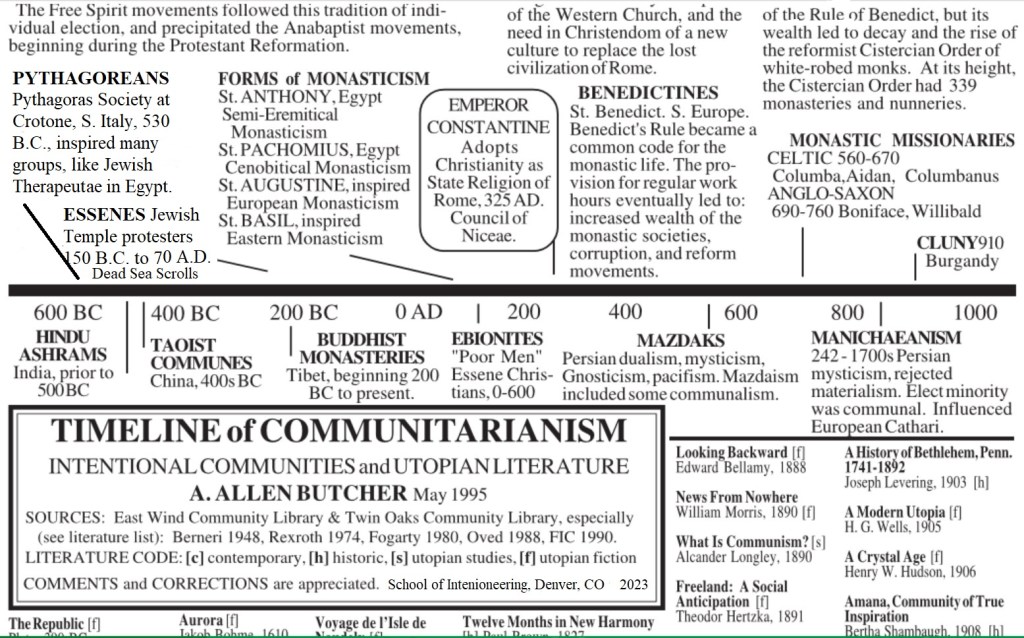


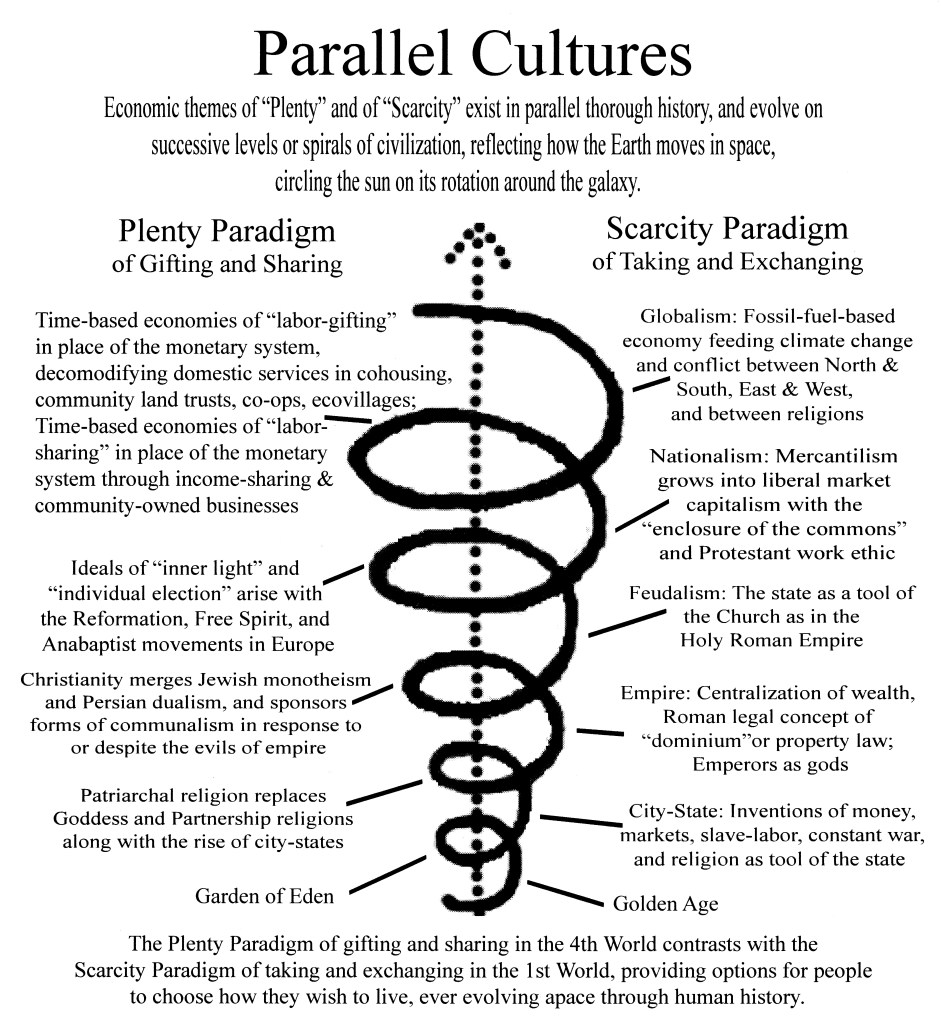
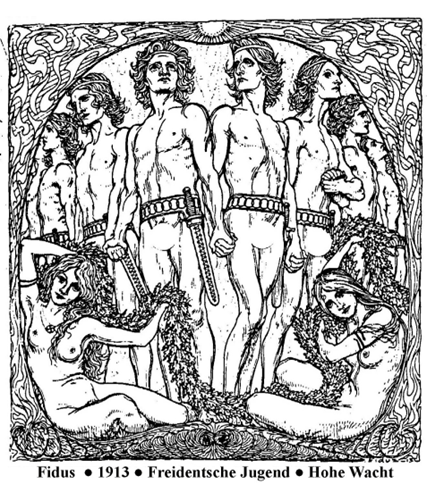



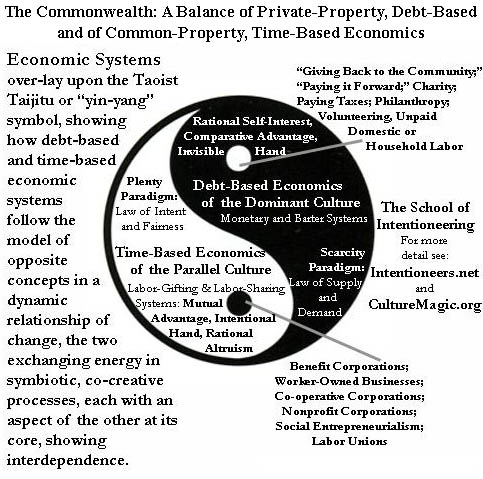


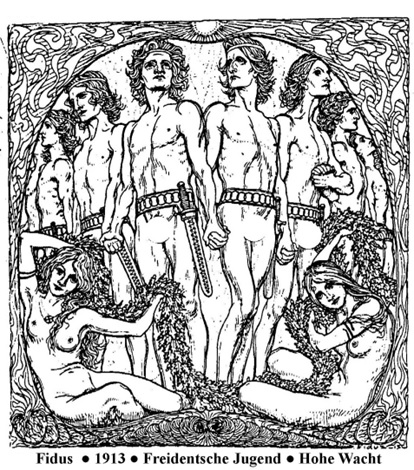
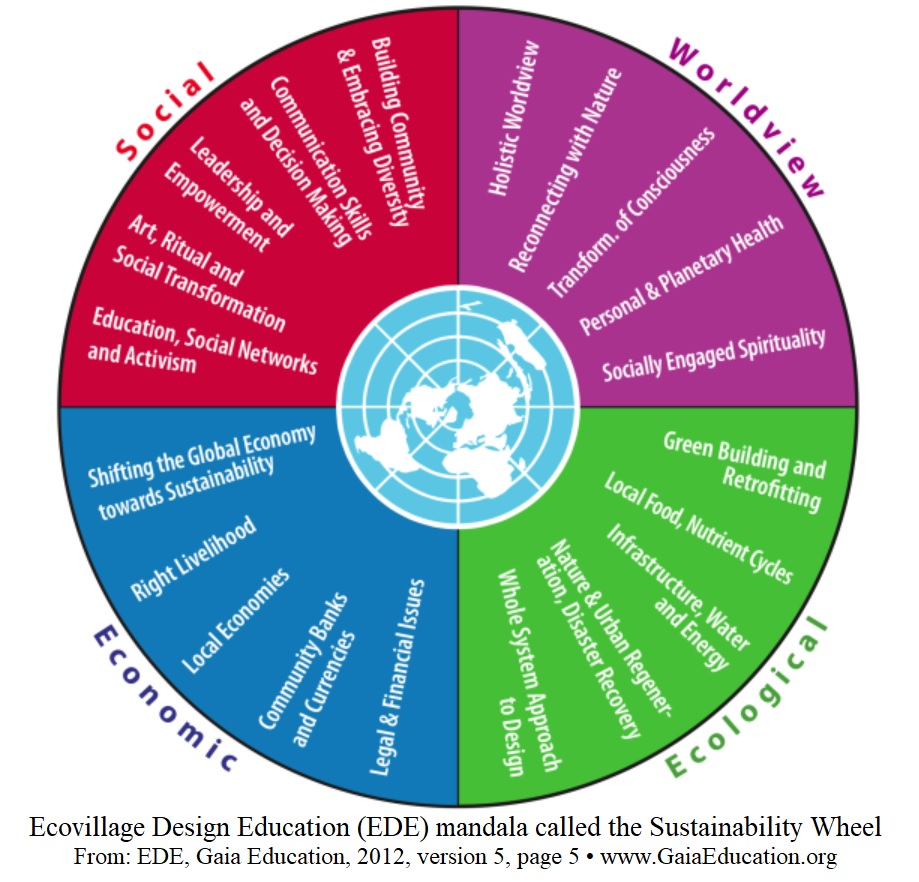
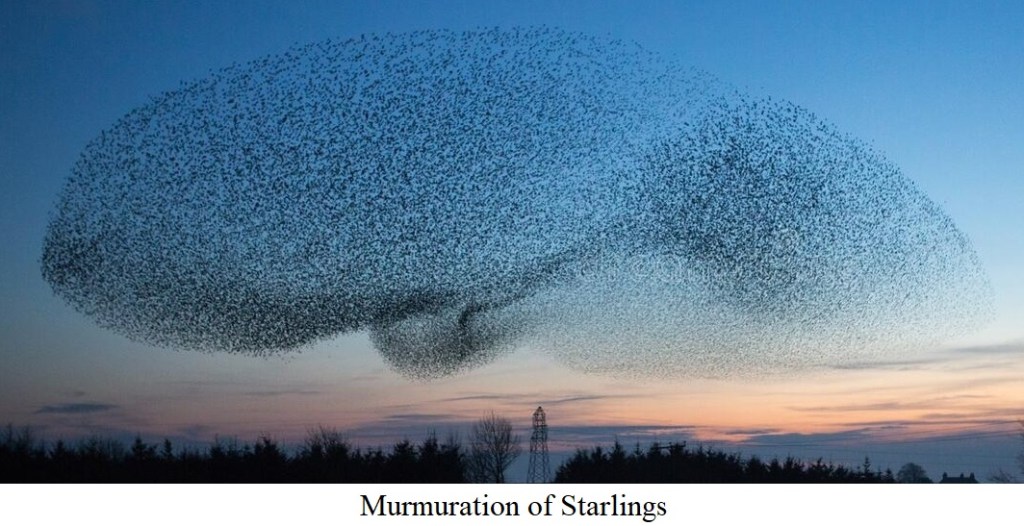
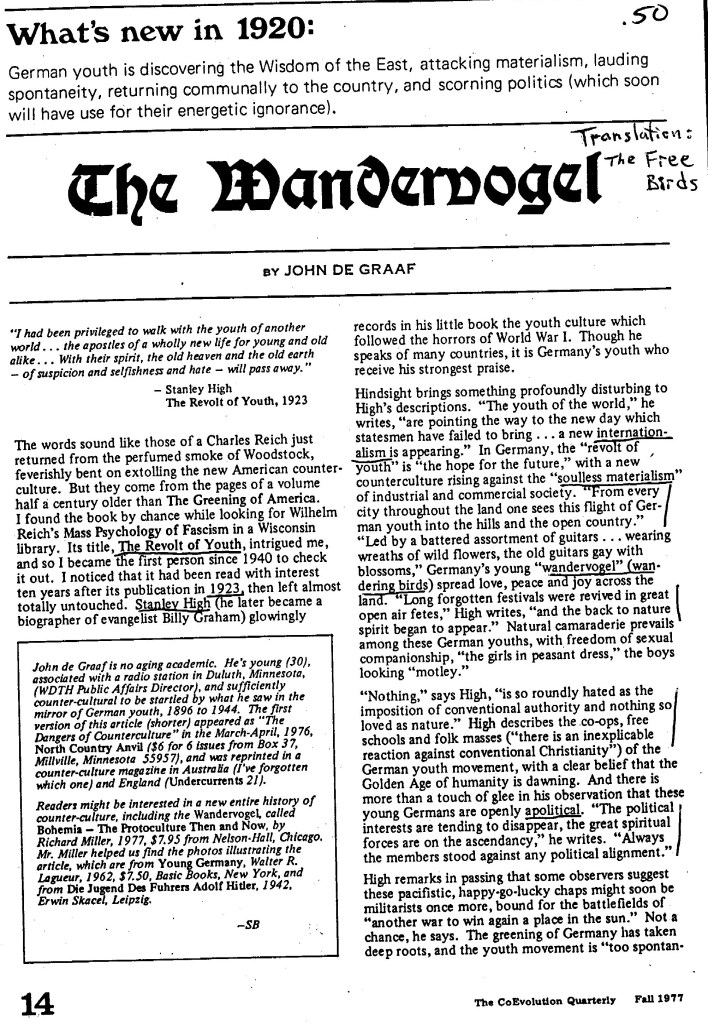


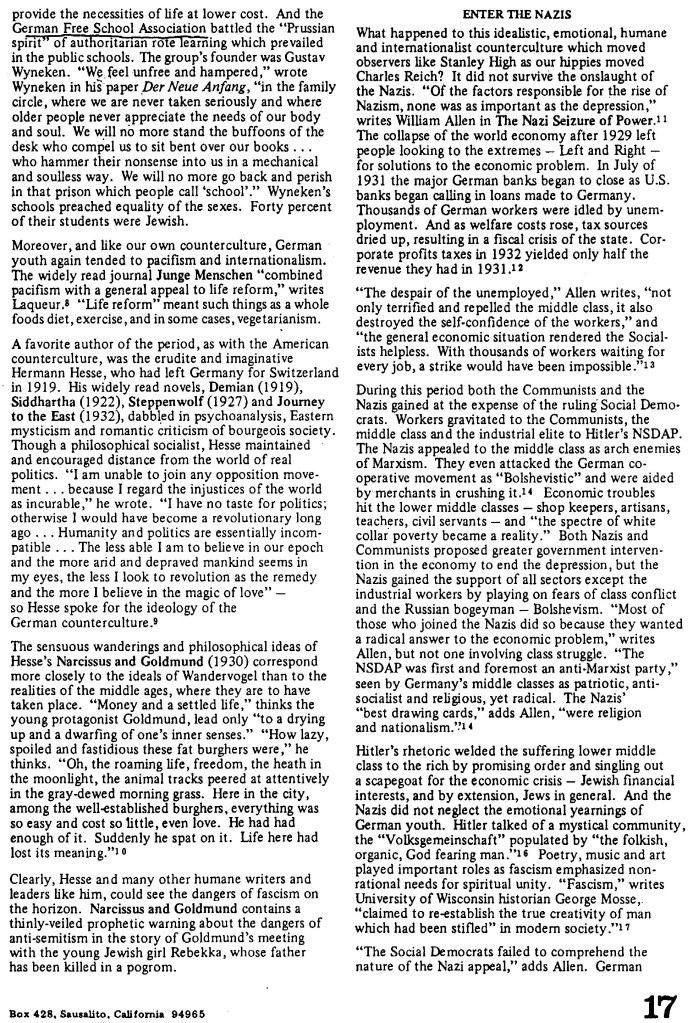

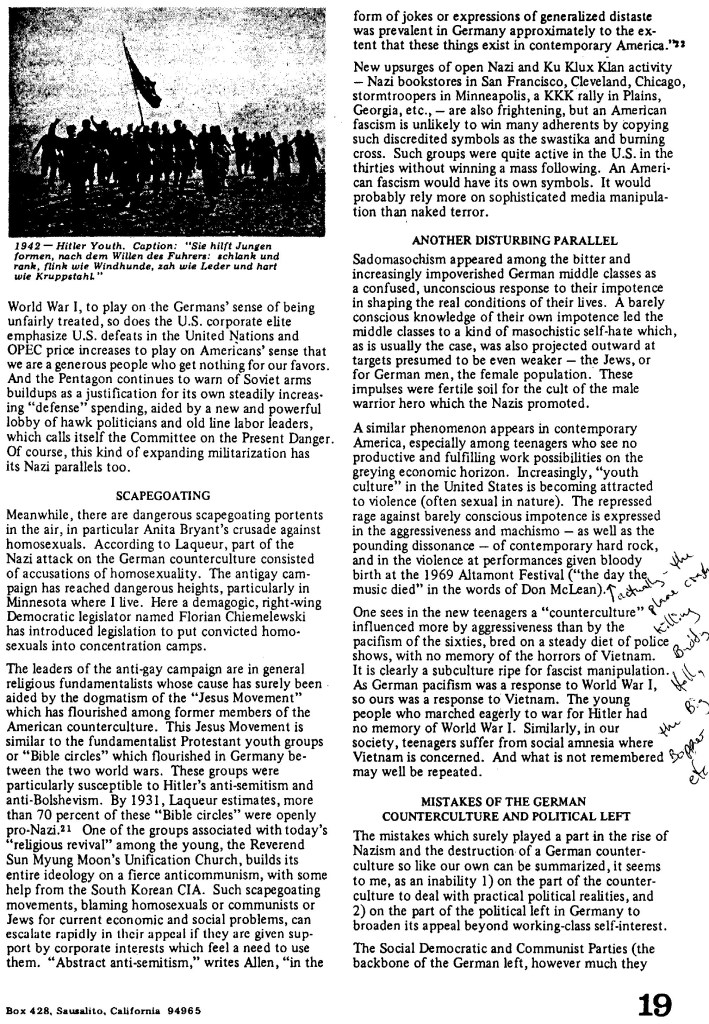

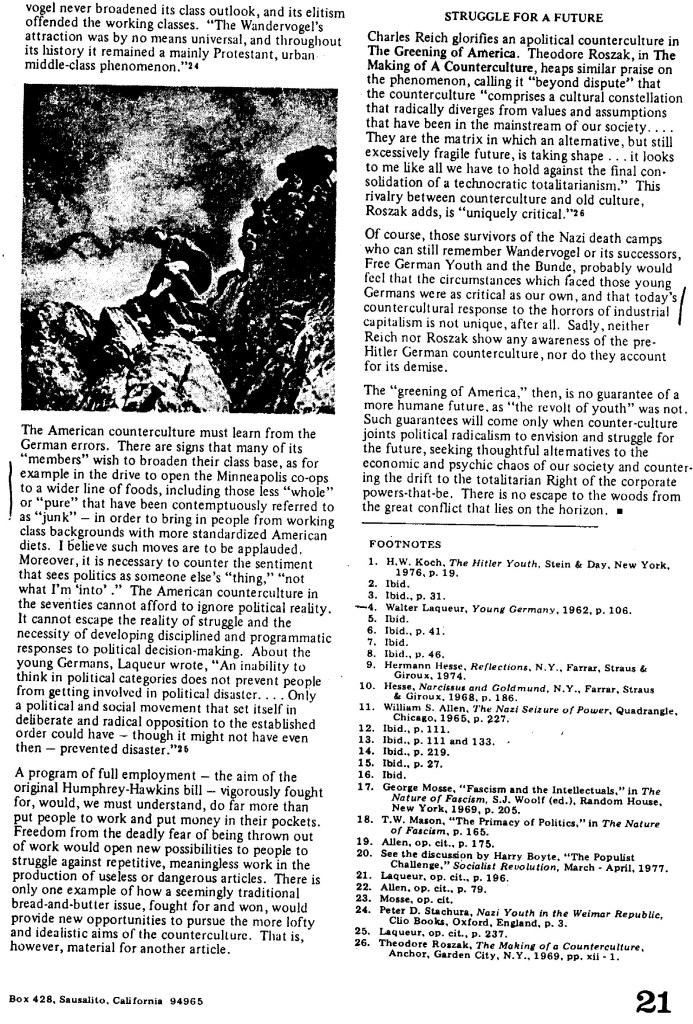


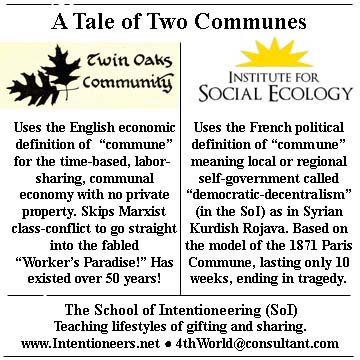






 Intentioneers